
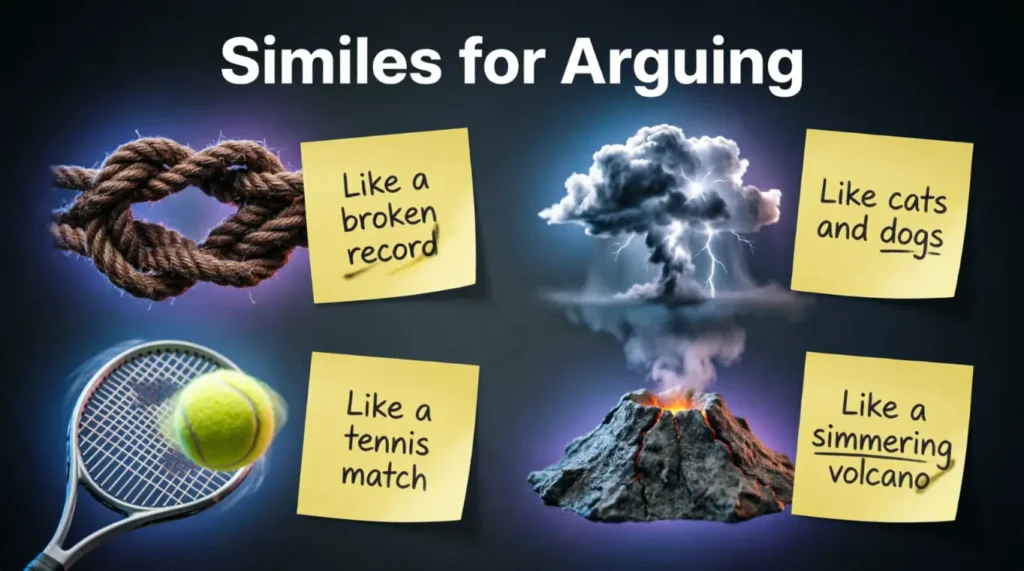
Arguments can become loud, tense, confusing, or even funny. Sometimes, simply saying that two people are arguing does not show the reader what the moment feels like. That is where similes for arguing can make your writing much stronger.
A simile compares two different things using words such as like or as. For example, you might say, “Their argument was like a storm.” This does not mean an actual storm appeared. Instead, it helps the reader imagine how wild and intense the disagreement became.
In simple terms, similes give your words a picture. They can make a character sound angry, frustrated, stubborn, defensive, or even calm during a disagreement. For example, “They argued like two barking dogs” creates a very different image from “They argued like two tired friends.”
So, let’s explore 50 similes for arguing that you can use in stories, essays, poems, conversations, and other creative writing. Each example includes its meaning, explanation, and two natural simile sentences.
50 Similes for Arguing
1. Arguing Like a Storm
Meaning: This means an argument is wild, powerful, and full of strong emotions.
Explanation: A storm can bring thunder, heavy rain, and strong winds. Comparing an argument to a storm shows that emotions are rising quickly.
Example sentences:
- Their argument was like a storm that shook the whole room.
- The two friends argued like a storm had suddenly entered their conversation.
2. Arguing Like Two Barking Dogs

Meaning: This describes two people speaking loudly and angrily at each other.
Explanation: Barking dogs can make a lot of noise when they face one another. This simile creates a clear picture of a noisy argument.
Example sentences:
- The brothers argued like two barking dogs.
- They stood in the kitchen, arguing like two dogs fighting over a bone.
3. Arguing Like Fire and Ice
Meaning: This describes two people with very different and opposing feelings or views.
Explanation: Fire and ice are opposites. Their contrast makes this simile useful when two people strongly disagree.
Example sentences:
- The two leaders argued like fire and ice.
- They were like fire and ice whenever the topic came up.
4. Arguing Like Thunder
Meaning: This suggests an argument is extremely loud and forceful.
Explanation: Thunder can be sudden and powerful. Comparing an argument to thunder highlights the volume and intensity of the voices.
Example sentences:
- Their voices crashed like thunder across the room.
- The couple argued like thunder rolling through the night.
5. Arguing Like a Volcano
Meaning: This means anger has built up and is now bursting out.
Explanation: A volcano may remain quiet before suddenly erupting. This makes it a strong comparison for an argument caused by bottled-up emotions.
Example sentences:
- Their argument erupted like a volcano.
- After weeks of silence, their disagreement exploded like a volcano.
6. Arguing Like a Battle
Meaning: This describes an argument that feels like a serious fight.
Explanation: A battle involves opposing sides trying to defeat each other. The comparison suggests that both people are strongly defending their positions.
Example sentences:
- Their discussion turned into an argument like a battle.
- They defended their opinions like soldiers in a battle.
7. Arguing Like Cats and Dogs
Meaning: This means two people argue often and seem unable to agree.
Explanation: Cats and dogs are commonly used as symbols of conflict. This familiar comparison works well in everyday writing.
Example sentences:
- The siblings argued like cats and dogs.
- They had been arguing like cats and dogs all morning.
8. Arguing Like a Raging River
Meaning: This suggests an argument that keeps moving and is difficult to stop.
Explanation: A raging river rushes forward with great force. The simile shows how quickly words and emotions can flow during a heated disagreement.
Example sentences:
- Their words rushed like a raging river.
- The argument flowed like a raging river that nobody could control.
9. Arguing Like a Broken Record
Meaning: This means someone keeps repeating the same point.
Explanation: A broken record repeats the same sound again and again. This simile works well when an argument goes around in circles.
Example sentences:
- He kept arguing like a broken record.
- She repeated the same complaint like a broken record.
10. Arguing Like a Boiling Pot
Meaning: This describes an argument filled with rising anger.
Explanation: A boiling pot becomes hotter until it bubbles over. Likewise, an argument can grow stronger as frustration builds.
Example sentences:
- Their conversation was like a boiling pot ready to spill over.
- The argument grew hotter like a boiling pot.
11. Arguing Like a Thunderstorm
Meaning: This means an argument is loud, dramatic, and intense.
Explanation: Thunderstorms combine loud sounds and sudden changes. The comparison helps readers imagine a chaotic disagreement.
Example sentences:
- Their argument was like a thunderstorm in the middle of dinner.
- The room sounded like a thunderstorm as they argued.
12. Arguing Like Two Roosters
Meaning: This describes people competing loudly to prove who is right.
Explanation: Roosters may act boldly when competing. This simile adds a slightly humorous feeling to an argument.
Example sentences:
- The two men argued like roosters fighting for attention.
- They strutted around and argued like two proud roosters.
13. Arguing Like a Tug-of-War
Meaning: This means both sides are pulling against each other without giving in.
Explanation: In tug-of-war, each team pulls in the opposite direction. The image fits arguments where neither person wants to surrender.
Example sentences:
- Their discussion felt like a tug-of-war.
- Every sentence became like another pull in a tug-of-war.
14. Arguing Like a Firecracker
Meaning: This suggests a short but sudden and explosive argument.
Explanation: A firecracker can burst loudly without warning. This simile works well for arguments that begin suddenly.
Example sentences:
- Their conversation exploded like a firecracker.
- The disagreement started like a firecracker in the quiet room.
15. Arguing Like a Boxing Match
Meaning: This describes an argument where both sides attack and defend their opinions.
Explanation: A boxing match has two opponents exchanging blows. Here, words take the place of punches.
Example sentences:
- Their debate felt like a boxing match.
- Every question landed like another punch in their verbal boxing match.
16. Arguing Like a Traffic Jam
Meaning: This means an argument becomes stuck and makes no progress.
Explanation: Cars in a traffic jam cannot move easily. Similarly, people can repeat their views without reaching an agreement.
Example sentences:
- Their discussion became like a traffic jam.
- The argument was stuck like cars in a traffic jam.
17. Arguing Like Waves Crashing on Rocks
Meaning: This suggests repeated arguments that keep hitting the same resistance.
Explanation: Waves repeatedly crash against rocks without moving them. The comparison shows persistence and resistance.
Example sentences:
- Their complaints came like waves crashing on rocks.
- She kept arguing like waves crashing against a cliff.
18. Arguing Like a Wildfire
Meaning: This means an argument spreads or grows very quickly.
Explanation: A wildfire can move rapidly across a large area. In the same way, one small disagreement can become a major conflict.
Example sentences:
- Their small disagreement spread like a wildfire.
- Anger moved through the family like a wildfire.
19. Arguing Like a Tornado
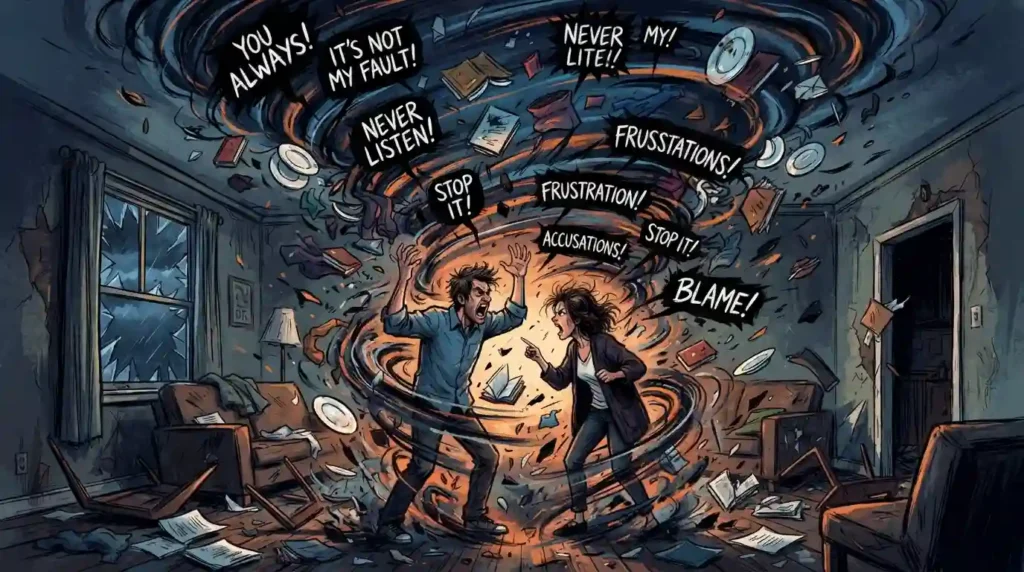
Meaning: This describes a chaotic and destructive argument.
Explanation: A tornado moves with great force and can cause disorder. The simile emphasizes the emotional chaos of the disagreement.
Example sentences:
- Their argument swept through the room like a tornado.
- The conversation became as chaotic as a tornado.
20. Arguing Like a Hammer Hitting a Nail
Meaning: This means someone keeps making the same strong point.
Explanation: A hammer strikes repeatedly. This comparison suggests persistence and forceful speech.
Example sentences:
- He argued like a hammer hitting a nail.
- She kept making her point like a hammer striking the same nail.
21. Arguing Like a Drumbeat
Meaning: This describes repeated words or complaints that continue without stopping.
Explanation: A drumbeat follows a steady rhythm. The simile can show how one person keeps repeating an argument.
Example sentences:
- His complaints continued like a drumbeat.
- Her questions came like a steady drumbeat.
22. Arguing Like a Wall of Sound
Meaning: This means the argument is so loud that individual voices become hard to separate.
Explanation: A wall of sound feels large and overwhelming. It creates a strong picture of a noisy disagreement.
Example sentences:
- Their voices rose like a wall of sound.
- The kitchen filled with a wall of sound as they argued.
23. Arguing Like a Pressure Cooker
Meaning: This means emotions have been building until they finally come out.
Explanation: A pressure cooker holds increasing pressure. This makes it a useful comparison for anger that has been held inside.
Example sentences:
- Their conversation felt like a pressure cooker.
- Months of frustration finally burst out like a pressure cooker.
24. Arguing Like Lightning
Meaning: This describes an argument that starts suddenly and strongly.
Explanation: Lightning appears quickly and can shock people. The simile emphasizes the sudden beginning of a disagreement.
Example sentences:
- The argument struck like lightning.
- Her angry reply came like lightning from a clear sky.
25. Arguing Like a Train Without Brakes
Meaning: This means an argument keeps getting stronger and seems impossible to stop.
Explanation: A train without brakes suggests unstoppable movement. It shows how a disagreement can continue even when both people want it to end.
Example sentences:
- Their argument rolled on like a train without brakes.
- The conversation became like a train without brakes.
26. Arguing Like a Sword Fight
Meaning: This describes a sharp exchange of words.
Explanation: In a sword fight, opponents attack and defend quickly. In an argument, sharp words can work in much the same way.
Example sentences:
- Their conversation sounded like a sword fight.
- Every sentence felt like another strike in a sword fight.
27. Arguing Like a Broken Clock
Meaning: This can describe an argument that keeps returning to the same point.
Explanation: A broken clock cannot move correctly. The comparison suggests that the discussion is stuck in one place.
Example sentences:
- Their argument went around like a broken clock.
- The discussion felt like a broken clock repeating the same moment.
28. Arguing Like a Stormy Sea
Meaning: This describes an argument full of emotional ups and downs.
Explanation: A stormy sea is rough and unpredictable. The simile shows how quickly emotions can change during conflict.
Example sentences:
- Their conversation was like a stormy sea.
- His emotions moved like a stormy sea during the argument.
29. Arguing Like Two Engines Racing
Meaning: This means both people are speaking quickly and forcefully.
Explanation: Racing engines are loud and powerful. The comparison highlights speed, energy, and competition.
Example sentences:
- They argued like two engines racing.
- Their voices sounded like engines racing down a track.
30. Arguing Like Bees Around Honey
Meaning: This can describe a noisy group arguing over something everyone wants.
Explanation: Bees gather around honey with great activity. The simile gives a busy, noisy feeling to the disagreement.
Example sentences:
- The children argued like bees around honey.
- Everyone crowded around the decision like bees around honey.
31. Arguing Like a Cracked Bell
Meaning: This describes an argument with harsh, unpleasant sounds.
Explanation: A cracked bell may produce an unpleasant noise. The comparison focuses on the sharp sound of angry voices.
Example sentences:
- Their voices rang like a cracked bell.
- The argument sounded like a cracked bell echoing through the hallway.
32. Arguing Like a Hurricane
Meaning: This means an argument is powerful, chaotic, and difficult to control.
Explanation: A hurricane can disturb everything around it. Likewise, a major argument can affect everyone nearby.
Example sentences:
- Their disagreement hit the family like a hurricane.
- The argument moved through the room like a hurricane.
33. Arguing Like a Drumline
Meaning: This describes a loud and rhythmic exchange of words.
Explanation: A drumline produces repeated, energetic sounds. This simile gives an argument a fast and noisy quality.
Example sentences:
- Their voices beat like a drumline.
- The questions and answers came like a fast drumline.
34. Arguing Like Two Trains on Separate Tracks
Meaning: This means two people are speaking but cannot understand each other’s point.
Explanation: Two trains on separate tracks move in different directions. The simile shows how people can remain focused on their own views.
Example sentences:
- They argued like two trains on separate tracks.
- Their opinions passed each other like trains on separate tracks.
35. Arguing Like Sparks From a Fire
Meaning: This means small comments quickly create more conflict.
Explanation: Sparks can jump from a fire and start new flames. Similarly, one angry remark can lead to another.
Example sentences:
- Their angry comments flew like sparks from a fire.
- Every insult created another spark in the argument.
36. Arguing Like a Door Slamming
Meaning: This suggests an argument is sharp, sudden, and emotionally forceful.
Explanation: A slamming door creates an abrupt and strong sound. The comparison captures the sudden impact of angry words.
Example sentences:
- Her reply came like a door slamming shut.
- His final words hit like a door slamming in the middle of the night.
37. Arguing Like a Drum and Cymbal
Meaning: This describes an argument filled with competing loud sounds.
Explanation: Drums and cymbals can create a powerful burst of noise. The simile works well for a heated exchange.
Example sentences:
- Their voices clashed like drums and cymbals.
- The kitchen sounded like drums and cymbals during the argument.
38. Arguing Like a Storm Inside a Bottle
Meaning: This describes intense emotions trapped in a small space.
Explanation: A storm inside a bottle is an impossible but vivid image. It suggests that strong feelings are struggling to escape.
Example sentences:
- Their argument felt like a storm inside a bottle.
- She carried her anger like a storm trapped inside a bottle.
39. Arguing Like Knives Clashing
Meaning: This describes a sharp and hostile exchange.
Explanation: Clashing knives create an image of danger and tension. Here, the words feel sharp rather than physical.
Example sentences:
- Their words clashed like knives.
- The conversation became as tense as knives clashing in the dark.
40. Arguing Like a Doorbell That Won’t Stop
Meaning: This means someone keeps talking or complaining without stopping.
Explanation: A nonstop doorbell quickly becomes irritating. The simile adds a humorous touch to repetitive arguing.
Example sentences:
- He argued like a doorbell that would not stop ringing.
- Her complaints continued like a doorbell ringing again and again.
41. Arguing Like a Storm Cloud Bursting
Meaning: This describes anger that suddenly comes out after building up.
Explanation: A dark storm cloud can release heavy rain. In the same way, hidden frustration can suddenly turn into an argument.
Example sentences:
- His anger burst out like a storm cloud.
- The disagreement came like a storm cloud bursting over them.
42. Arguing Like a Chain Reaction
Meaning: This means one disagreement causes another and another.
Explanation: A chain reaction begins with one event and quickly causes more events. This makes it useful for describing arguments that grow step by step.
Example sentences:
- Their small disagreement became like a chain reaction.
- One angry comment started a chain reaction of arguments.
43. Arguing Like a Match Striking a Dry Forest
Meaning: This describes a tiny disagreement that quickly becomes a major conflict.
Explanation: A single spark can spread quickly in dry conditions. The simile shows how a small comment can create a much bigger argument.
Example sentences:
- His joke was like a match striking a dry forest.
- One careless word started an argument like a match in a dry forest.
44. Arguing Like a Drum in a Quiet Room
Meaning: This describes an argument that feels especially loud because everything around it is calm.
Explanation: A drum sounds much louder in silence. The comparison creates a strong contrast between peace and conflict.
Example sentences:
- Their voices sounded like a drum in a quiet room.
- The sudden argument hit the house like a drum in silence.
45. Arguing Like Waves in a Storm
Meaning: This describes repeated emotional attacks that rise and fall.
Explanation: Storm waves keep moving and crashing. The simile shows how arguments can come in repeated bursts.
Example sentences:
- Their accusations came like waves in a storm.
- Angry words rose and fell like waves in a storm.
46. Arguing Like a Racing Heart
Meaning: This suggests an argument filled with nervousness, anger, or excitement.
Explanation: A racing heart often signals strong emotion. The comparison focuses on how tense an argument can feel.
Example sentences:
- Their argument felt like a racing heart.
- Her words came quickly, like a racing heart.
47. Arguing Like Thunder in a Small Room
Meaning: This describes a very loud argument in a confined space.
Explanation: Thunder already sounds powerful, while a small room makes the sound feel even stronger.
Example sentences:
- Their voices echoed like thunder in a small room.
- The argument sounded like thunder trapped inside the kitchen.
48. Arguing Like Two Radios on Different Stations
Meaning: This means two people are talking but are not truly listening to each other.
Explanation: Two radios playing different stations create confusing sounds. The comparison shows a lack of communication.
Example sentences:
- They argued like two radios on different stations.
- Their conversation was like two radios playing at once.
49. Arguing Like a Fire That Keeps Growing
Meaning: This means an argument becomes more intense over time.
Explanation: A growing fire becomes hotter and harder to control. The simile shows how anger can increase with every new comment.
Example sentences:
- Their disagreement grew like a fire.
- Every new accusation made the argument burn like a growing fire.
50. Arguing Like a Storm That Refuses to Pass
Meaning: This describes a disagreement that lasts for a long time.
Explanation: A storm that refuses to pass creates a feeling of endless tension. It works well when characters cannot move past a conflict.
Example sentences:
- Their argument was like a storm that refused to pass.
- The tension hung over them like a storm that would not leave.
Simile vs. Metaphor
Similes and metaphors both help writers create strong mental pictures, but they work in different ways.
A simile makes a comparison using words such as like or as. For example:
Their argument was like a storm.
A metaphor makes the comparison directly:
Their argument was a storm.
In simple terms, a simile tells the reader that one thing is similar to another. A metaphor treats the two things as if they are the same.
Both can make creative writing more interesting. However, similes are often easier for beginners because the comparison is clear.
How to Use Similes in Writing
When you want to create your own simile, first think about the feeling you want to show.
Is the argument:
- Loud?
- Suddenly?
- Long?
- Confusing?
- Angry?
- Repetitive?
- Difficult to stop?
Next, choose something that shares that quality.
For example, if the argument is loud, you could compare it to thunder.
If it is hard to stop, you might compare it to a train without brakes.
If it is repetitive, you could compare it to a broken record.
This simple method can help you create natural simile sentences without making your writing sound forced.
FAQs
What’s another word for arguing?
Some alternatives are disputing, debating, quarreling, bickering, disagreeing, or clashing. The best choice depends on the tone and situation.
What can I say instead of “I argue”?
You can say “I disagree,” “I debate,” “I challenge that idea,” “I make my case,” or “I defend my position.”
What is a metaphor for arguing?
Common metaphors include “a battle of words,” “a war of ideas,” “a verbal tug-of-war,” or “a clash of opinions.”
What’s another way to say “I argue”?
Try “I contend,” “I maintain,” “I assert,” “I reason,” or “I make the case that.” These can sound more formal and professional.
What is slang for arguing?
Informal expressions include “going at it,” “beefing,” “going back and forth,” “butting heads,” and “getting into it.”
How do you say “argue professionally”?
Use phrases such as “disagree respectfully,” “present a counterargument,” “challenge the proposal,” or “discuss opposing viewpoints.” These sound constructive rather than confrontational.
Conclusion
Similes can turn a simple argument into a scene readers can almost see and hear. Instead of saying that two characters are angry, you can show their emotions through a powerful comparison. An argument can be like a storm, a volcano, a boxing match, or a train without brakes.
The best similes do more than decorate your writing. They help readers understand the mood, emotion, and action behind your words. So, when you are working on a story, poem, essay, or dialogue, think about what the argument feels like.
Then ask yourself: What else behaves, sounds, or feels this way?
That question can lead you to your own creative writing similes. With practice, you will find it easier to understand the meaning of similes and learn how to use similes in writing naturally.

I am Katherine Applegate inspires young readers through imaginative stories about animals, friendship, courage, and resilience. I explore creative similes, vocabulary, and student-friendly English resources at Publivexa.com.