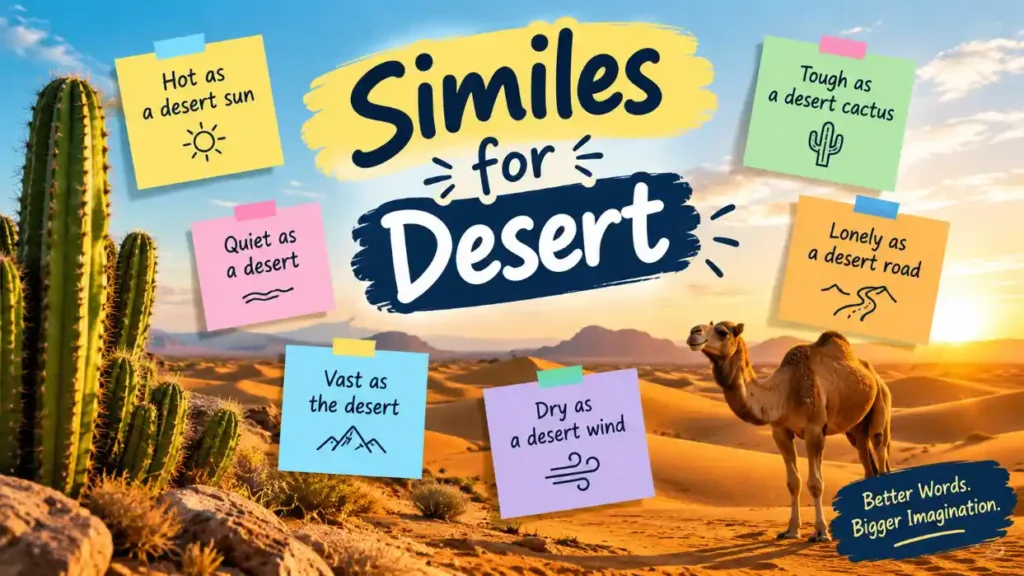
A desert can look empty at first, but it is full of amazing details. The sand moves, the sun burns, and the wind leaves tiny marks across the ground. Similes for desert help writers describe these scenes in a way readers can easily imagine.
A simile compares two different things using words such as “like” or “as.” For example, you might say, “The desert was as hot as an oven.” The desert is not really an oven, but this comparison helps us feel its intense heat.
In simple terms, similes turn plain descriptions into colorful pictures. They are useful in stories, poems, essays, and other creative writing. Instead of saying, “The sand was hot,” you could write, “The sand was as hot as burning coals.”
Let’s explore 50 creative writing similes for the desert, along with their meanings, explanations, and simile sentences. These examples can help you understand the meaning of similes and learn how to use similes in writing.
50 Similes for Desert
1. The desert was as hot as an oven.
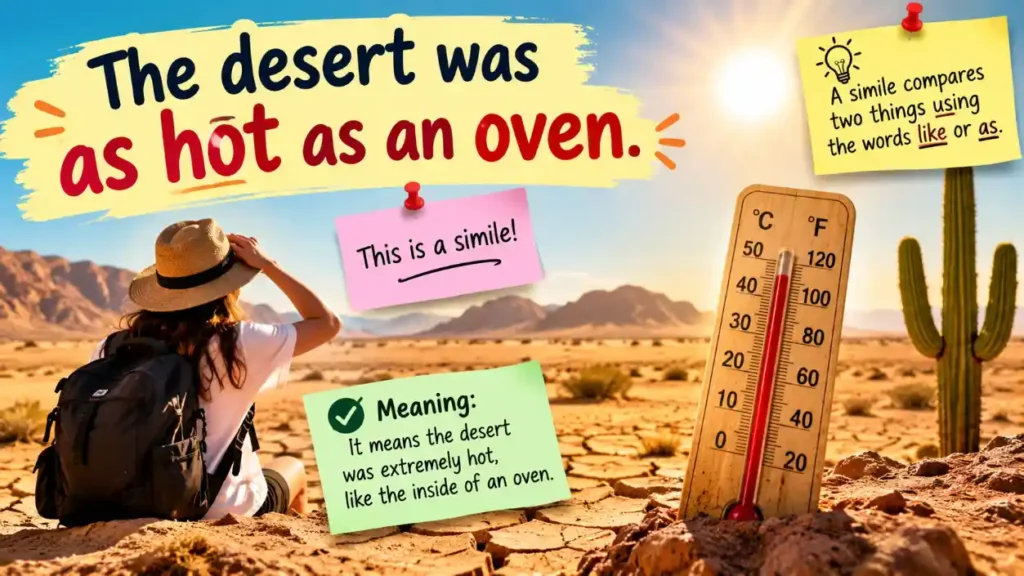
Meaning: Extremely hot.
Explanation: This comparison shows that the desert has intense heat, much like the inside of a hot oven.
The sand felt as hot as an oven beneath my feet.
By noon, the desert was as hot as an oven.
2. The desert was as dry as a bone.
Meaning: Very dry.
Explanation: This simile emphasizes the lack of water and moisture in the desert.
The ground was as dry as a bone after months without rain.
Everything around us looked as dry as a bone.
3. The sand was like golden silk.
Meaning: Soft, smooth, and golden.
Explanation: Comparing sand to silk highlights its smooth texture and beautiful golden color.
The dunes looked like golden silk under the morning sun.
Fine sand flowed through my fingers like golden silk.
4. The desert sun was like a blazing fire.
Meaning: Extremely hot and powerful.
Explanation: This comparison makes the sun seem fierce and burning.
The desert sun felt like a blazing fire above us.
At midday, the sun shone like a blazing fire.
5. The dunes rose like giant waves.
Meaning: The dunes were large and curved.
Explanation: Sand dunes can have shapes similar to ocean waves, especially when viewed from a distance.
The golden dunes rose like giant waves across the land.
From the hill, the sand looked like giant waves frozen in place.
6. The desert was as quiet as a sleeping baby.
Meaning: Very peaceful and silent.
Explanation: This simile shows how little sound can be heard in a quiet desert.
At dawn, the desert was as quiet as a sleeping baby.
We stood still because the desert was as quiet as a sleeping baby.
7. The sand glittered like tiny diamonds.
Meaning: The sand looked bright and sparkling.
Explanation: Sunlight can reflect from small grains of sand, making them appear to sparkle.
The sand glittered like tiny diamonds in the sunlight.
Across the dune, the grains shone like tiny diamonds.
8. The wind moved through the desert like a whisper.
Meaning: The wind moved softly and quietly.
Explanation: This comparison creates a calm image of gentle desert wind.
The cool breeze moved through the dunes like a whisper.
At sunset, the wind passed like a whisper across the sand.
9. The desert was as vast as an ocean.
Meaning: Extremely large and wide.
Explanation: This simile helps readers imagine the enormous size of the desert.
The endless desert seemed as vast as an ocean.
From the mountain, the sandy land looked as vast as an ocean.
10. The cactus stood like a lonely soldier.
Meaning: The cactus appeared alone and strong.
Explanation: A cactus standing by itself can look like a guard protecting the desert.
One tall cactus stood like a lonely soldier.
Against the empty horizon, the plant looked like a lonely soldier.
11. The desert floor was as cracked as old pottery.
Meaning: Very dry and covered with cracks.
Explanation: Dry ground can split into patterns that resemble broken pottery.
The desert floor was as cracked as old pottery.
After the long drought, the earth looked as cracked as old pottery.
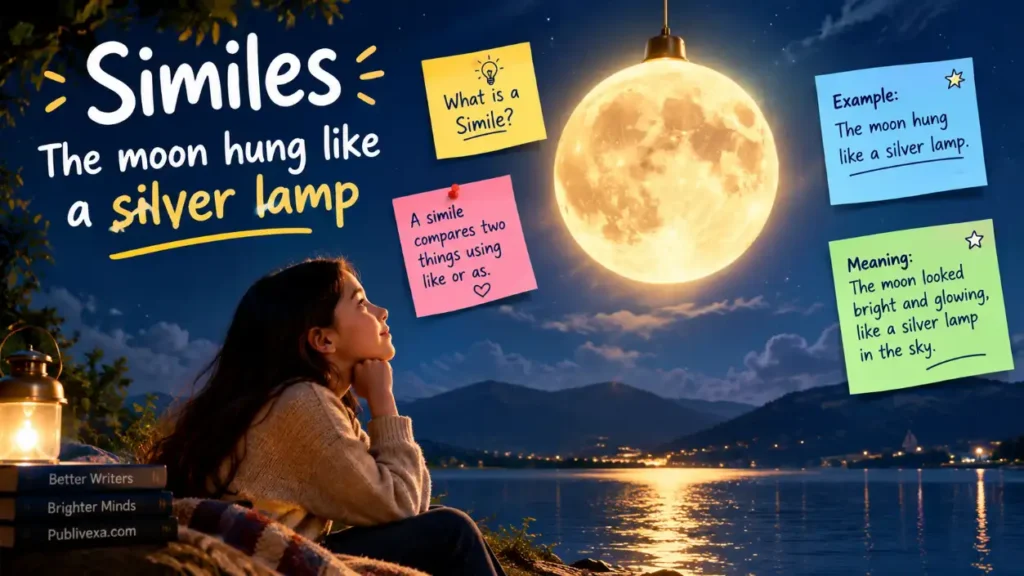
12. The moon hung like a silver lamp.
Meaning: The moon gave a soft light at night.
Explanation: This comparison makes the moon seem like a lamp shining over the dark desert.
The moon hung like a silver lamp above the dunes.
At night, the moon looked like a silver lamp in the sky.
13. The stars were like scattered diamonds.
Meaning: The stars looked bright and numerous.
Explanation: This simile creates a beautiful picture of a clear desert night.
The stars were like scattered diamonds above our camp.
Across the dark sky, stars appeared like scattered diamonds.
14. The night was as dark as ink.
Meaning: Very dark.
Explanation: Ink is usually deep and dark, so it helps show how black the desert night appeared.
The desert night was as dark as ink.
Without the moon, the sky looked as dark as ink.
15. The camel walked like a slow-moving ship.
Meaning: The camel moved slowly and steadily.
Explanation: A camel’s steady movement can remind us of a large ship moving across water.
The camel walked like a slow-moving ship across the dunes.
Our guide’s camel moved like a slow-moving ship.
16. The desert heat was like a blanket of fire.
Meaning: The heat felt heavy and burning.
Explanation: This comparison makes the hot air seem like something covering the whole desert.
The desert heat felt like a blanket of fire.
By afternoon, a blanket of fire seemed to cover the land.
17. The sand was as soft as flour.
Meaning: Very fine and soft.
Explanation: Fine desert sand can feel smooth and powdery like flour.
The sand beneath us was as soft as flour.
My hands sank into sand as soft as flour.
18. The rocks were as hard as iron.
Meaning: Extremely hard.
Explanation: Iron is strong and hard, making it a useful comparison for solid desert rocks.
The ancient rocks were as hard as iron.
We climbed over stones that felt as hard as iron.
19. The desert stretched like an endless carpet.
Meaning: The desert seemed to continue for a very long distance.
Explanation: This simile emphasizes the wide, continuous appearance of the sandy ground.
The desert stretched like an endless carpet before us.
Golden sand spread like an endless carpet beneath the sky.
20. The sun burned like a torch.
Meaning: The sun gave off intense heat and light.
Explanation: A torch produces bright light and heat, so it creates a strong image of the desert sun.
The afternoon sun burned like a torch.
Above the dunes, the sun glowed like a giant torch.
21. The oasis was like a green jewel.
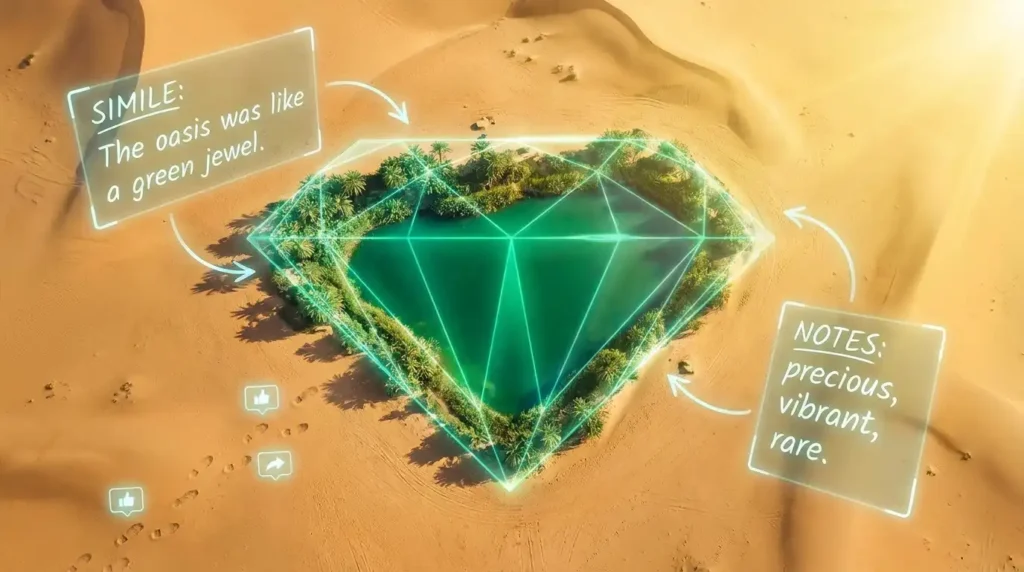
Meaning: The oasis looked beautiful and precious.
Explanation: A green oasis in a dry desert can stand out like a valuable jewel.
The oasis appeared like a green jewel in the distance.
Travelers smiled when they saw the oasis shining like a green jewel.
22. The desert looked as empty as a blank page.
Meaning: The desert appeared wide and free of objects.
Explanation: A blank page has nothing written on it, making it a good comparison for an open desert landscape.
The plane looked as empty as a blank page.
From the hill, the desert seemed as empty as a blank page.
23. The wind was as dry as a dusty road.
Meaning: The air had very little moisture.
Explanation: This comparison emphasizes the dry feeling of desert air.
The afternoon wind was as dry as a dusty road.
A dry breeze touched my face like air from a dusty road.
24. The dunes looked like sleeping giants.
Meaning: The dunes appeared huge and still.
Explanation: Large dunes can resemble giant bodies resting across the landscape.
The dunes looked like sleeping giants beneath the sun.
In the evening light, the hills of sand seemed like sleeping giants.
25. The desert was as still as a statue.
Meaning: Completely calm and motionless.
Explanation: A statue does not move, so this simile creates a picture of a very still desert.
The desert was as still as a statue before sunrise.
For a moment, everything around us seemed as still as a statue.
26. The sandstorm moved like a roaring beast.
Meaning: The sandstorm was powerful and frightening.
Explanation: A strong sandstorm can move quickly and make loud sounds, much like a wild animal.
The sandstorm rushed toward us like a roaring beast.
Across the horizon, the storm moved like a roaring beast.
27. The desert sky was as blue as glass.
Meaning: The sky looked clear and bright blue.
Explanation: This comparison highlights the clean, bright appearance of the sky on a clear day.
The desert sky was as blue as glass.
Above the dunes, the sky looked as blue as glass.
28. The sunset spread like spilled paint.
Meaning: The sunset filled the sky with bright colors.
Explanation: Red, orange, pink, and gold colors can spread across the sky like paint.
The sunset spread across the desert like spilled paint.
Orange light moved over the dunes like spilled paint.
29. The horizon was like a golden line.
Meaning: The distant edge of the land looked bright and golden.
Explanation: This simile creates a simple visual picture of the far edge of the desert.
The horizon looked like a golden line at sunset.
Far away, the desert ended like a golden line beneath the sky.
30. The desert air felt like a hot breath.
Meaning: The air was extremely warm.
Explanation: Hot air can feel similar to warm breath against your skin.
The desert air felt like a hot breath on my face.
When we stepped outside, the air hit us like a hot breath.
31. The cactus was as green as an emerald.
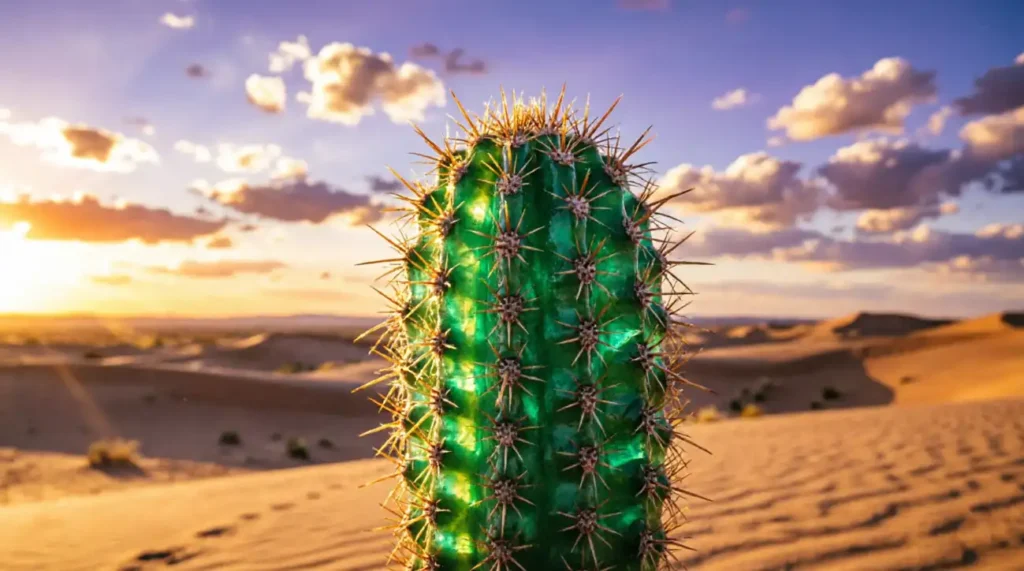
Meaning: The cactus had a rich, bright green color.
Explanation: Emeralds are known for their beautiful green color, making this comparison useful for describing plants.
The cactus was as green as an emerald.
Against the brown sand, the plant looked as green as an emerald.
32. The desert path was like a winding ribbon.
Meaning: The path curved and stretched across the sand.
Explanation: A ribbon can bend and twist, just like a desert trail that winds between dunes.
The trail moved through the dunes like a winding ribbon.
Our desert path stretched like a winding ribbon.
33. The camel’s feet were like soft brushes.
Meaning: The camel’s feet moved gently over the sand.
Explanation: This comparison focuses on the way a camel’s feet spread across and move over sandy ground.
The camel’s feet touched the sand like soft brushes.
Each step looked like a soft brush moving across the dune.
34. The desert morning was as fresh as a new day.
Meaning: The morning felt clean, cool, and refreshing.
Explanation: Early desert mornings can feel much cooler and fresher than the hot afternoon.
The desert morning felt as fresh as a new day.
Cool air made the sunrise seem as fresh as a new day.
35. The stars shone like lanterns.
Meaning: The stars gave bright points of light.
Explanation: Lanterns provide light in darkness, making them a natural comparison for stars.
The stars shone like lanterns above our camp.
Tiny stars sparkled like lanterns in the night sky.
36. The desert cold was as sharp as ice.
Meaning: The nighttime cold felt intense.
Explanation: Deserts can become very cold after sunset, and this simile emphasizes the sharp feeling of the cold.
The nighttime air was as sharp as ice.
After sunset, the desert became as cold as ice.
37. The sandstorm was like a giant curtain.
Meaning: The storm covered the landscape.
Explanation: A thick wall of blowing sand can look like a curtain hiding everything behind it.
The sandstorm moved across the land like a giant curtain.
A wall of dust appeared like a giant curtain.
38. The desert rocks were like ancient bones.
Meaning: The rocks looked old, dry, and pale.
Explanation: This comparison creates an ancient and mysterious feeling.
The pale rocks looked like ancient bones.
Across the valley, strange stones appeared like ancient bones.
39. The dry bushes were as brittle as paper.
Meaning: The bushes were very dry and easy to break.
Explanation: Dry plants can become fragile, much like a thin sheet of paper.
The desert bushes were as brittle as paper.
One dry branch felt as brittle as paper.
40. The desert road was as straight as an arrow.
Meaning: The road had almost no curves.
Explanation: An arrow travels in a straight direction, so this simile emphasizes a very straight desert road.
The highway was as straight as an arrow.
We drove along a road as straight as an arrow.
41. The heat shimmered like a dancing ghost.
Meaning: The hot air created a strange moving effect.
Explanation: Heat rising from the desert can make distant objects appear to move or shake.
The air shimmered like a dancing ghost above the sand.
Faraway rocks seemed to move like dancing ghosts.
42. The desert was as golden as a treasure chest.
Meaning: The desert looked rich and golden.
Explanation: Golden sand can remind readers of gold or treasure.
At sunset, the desert was as golden as a treasure chest.
The dunes glowed as golden as a treasure chest.
43. The oasis looked like a hidden paradise.
Meaning: The oasis seemed beautiful and peaceful.
Explanation: Finding green water and plants in a dry desert can feel like discovering a wonderful secret place.
The small oasis looked like a hidden paradise.
After hours of travel, the trees appeared like a hidden paradise.
44. The desert wind howled like a wolf.
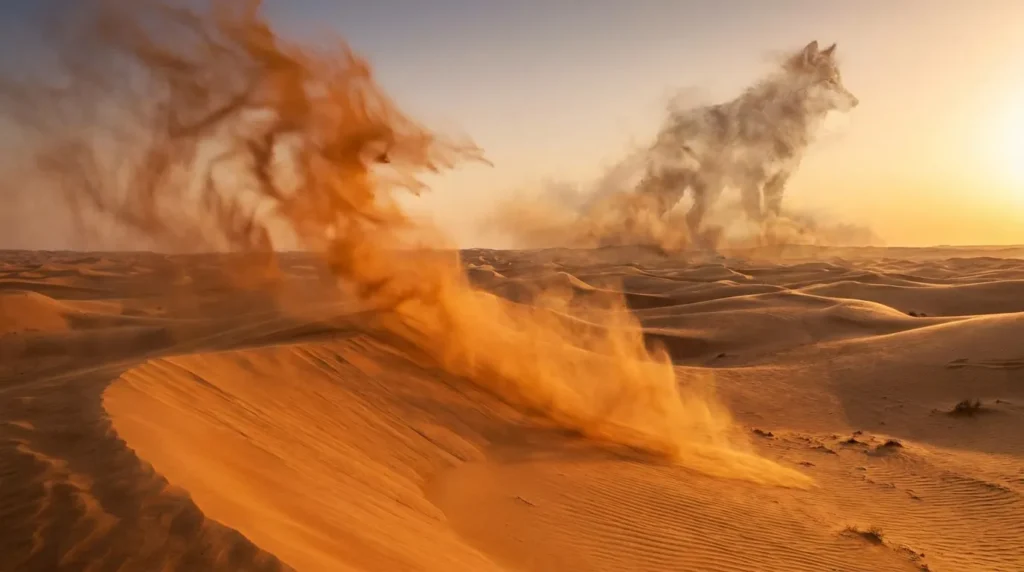
Meaning: The wind made a loud, eerie sound.
Explanation: Strong wind can produce sounds that resemble the howl of a wolf.
The desert wind howled like a wolf at night.
Around our tent, the wind sounded like a lonely wolf.
45. The sand felt like warm sugar.
Meaning: The sand felt fine and warm.
Explanation: This simile combines the fine texture of sugar with the warmth of desert sand.
The sand slipped through my hands like warm sugar.
Under the evening sun, the grains felt like warm sugar.
46. The desert night was like a velvet blanket.
Meaning: The night felt dark, smooth, and peaceful.
Explanation: Velvet is soft and rich, while a blanket can cover something completely. Together, they create a calm image of the night sky.
The dark desert night was like a velvet blanket.
Stars appeared across the sky like a velvet blanket.
47. The moonlight was as soft as a feather.
Meaning: The moonlight looked gentle and delicate.
Explanation: A feather is light and soft, making it a good comparison for gentle moonlight.
Moonlight fell on the dunes as softly as a feather.
The pale glow was as soft as a feather.
48. The desert seemed like a sea of sand.
Meaning: Huge amounts of sand covered the land.
Explanation: Comparing the desert to a sea helps readers imagine waves of dunes spreading far into the distance.
The desert looked like a sea of sand.
We traveled across a sea of sand beneath the bright sun.
49. The desert sunset was as bright as a flame.
Meaning: The sunset had strong orange and red colors.
Explanation: A flame is bright and warm, so this comparison makes the sunset feel vivid.
The desert sunset was as bright as a flame.
Red clouds glowed as bright as a flame above the dunes.
50. The desert was like a giant natural painting.
Meaning: The desert looked beautiful and artistic.
Explanation: Sand, sunlight, rocks, plants, and sky can combine to create a scene that looks like a carefully painted picture.
At sunset, the desert looked like a giant natural painting.
The colorful dunes appeared like a giant natural painting.
Simile vs. Metaphor: What Is the Difference?
Similes and metaphors both make writing more interesting, but they work in different ways.
A simile directly compares two things by using “like” or “as.”
The desert was as hot as an oven.
A metaphor makes the comparison directly without using “like” or “as.”
The desert was an oven.
In the first sentence, the desert is compared to an oven. In the second, the writer says the desert is an oven to create a stronger image.
Quick Comparison
| Simile | Metaphor |
| Uses “like” or “as” | Usually does not use “like” or “as” |
| The sand was like gold. | The sand was gold. |
| The desert was as hot as fire. | The desert was a furnace. |
| Makes a clear comparison | Makes a direct comparison |
So, when learning how to use similes in writing, look for comparison words such as like, as, similar to, or as…as.
Practical Exercise:
Try these questions before looking at the answers. See if you can complete or identify each simile.
1. Complete the simile: The desert was as hot as ________.
an oven.
2. Which sentence contains a simile: “The desert was an oven” or “The desert was like an oven”?
“The desert was like an oven.”
3. Complete the simile: The sand glittered like ________.
tiny diamonds.
4. What does this simile mean: “The dunes rose like giant waves”?
The dunes were large, curved, and wave-like.
5. Complete the simile: The desert was as dry as ________.
a bone.
6. Which comparison is a simile: “The stars were scattered diamonds” or “The stars were like scattered diamonds”?
“The stars were like scattered diamonds.”
7. What does “The desert was as quiet as a sleeping baby” describe?
It describes a very quiet and peaceful desert.
8. Complete the simile: The cactus stood like a ________.
lonely soldier.
9. Is this a simile or metaphor: “The desert was a sea of sand”?
Metaphor.
10. Write your own simile about a desert using “as.”
Example: “The desert sun was as bright as a flame.”
How to Create Your Own Desert Similes
Creating your own creative writing similes is easier than it may seem. Start by choosing one thing you want to describe.
For example, you might choose:
- Heat
- Sand
- Sun
- Wind
- Dunes
- Night
- Stars
- Cactus
- Rocks
Next, think about something that shares a similar quality.
For example:
Heat → fire
Now connect the two ideas:
The desert heat was like a fire.
You can also use the “as…as” pattern:
The desert was as hot as fire.
Try to choose comparisons that help readers see, hear, feel, or imagine the desert. A strong simile should add a clear picture instead of simply adding extra words.
Why Are Similes Important in Writing?
Similes make ordinary sentences more memorable. They help readers build a picture in their minds without needing a long description.
For instance, “The sand was hot” gives us a basic fact. However, “The sand was as hot as burning coals” gives us a stronger feeling.
Good similes can also create mood. A comparison such as “the desert wind howled like a wolf” feels mysterious and slightly scary. On the other hand, “the moonlight was as soft as a feather” creates a peaceful mood.
That is why writers often use examples of similes in stories, poems, school assignments, and descriptive paragraphs.
Final Thoughts
Similes give desert descriptions more life, color, and feeling. Instead of simply saying that the desert is hot, dry, wide, or quiet, you can compare those qualities to familiar things. For example, the sand can glitter like diamonds, the dunes can rise like giant waves, and the stars can shine like lanterns.
The best part is that you do not need complicated words to create strong comparisons. Start with something simple, think about what it reminds you of, and connect the two ideas using like or as.
Now it is your turn. Pick one desert feature and create your own simile. With practice, your writing can become clearer, more vivid, and much more fun to read.

I am Jerry Spinelli’s inspiring children’s stories encourage creativity, individuality, and confidence, while Publivexa.com supports students with similes, vocabulary, writing ideas, and English learning resources.