
Homework can feel like a mountain after a long school day. Sometimes, finding the right words to describe that feeling can be just as hard as finishing the work itself. That is where similes for homework can help.
A simile compares two different things using words such as “like” or “as.” For example, you might say, “My homework was as heavy as a mountain.” Of course, homework is not really a mountain. The comparison simply shows that it felt difficult or overwhelming.
In simple terms, similes make ordinary ideas more colorful. They help readers picture a feeling, action, or situation in their minds. They are also useful for students who want to make their writing more interesting.
In this guide, let’s explore 50 similes for homework with simple meanings, explanations, and example sentences. You will also learn how to use similes in writing and create your own creative comparisons.
What Is a Simile?
A simile is a figure of speech that compares one thing with another. It usually uses “like” or “as.”
For example:
My homework was like a mountain.
This does not mean the homework was actually a mountain. Instead, the comparison shows that the homework felt large, difficult, or hard to finish.
Similes are common in stories, poems, school assignments, and everyday conversations. They can turn a plain sentence into a more vivid one.
For example:
- Plain: The homework was difficult.
- With a simile: The homework was as difficult as climbing a mountain.
The second sentence gives you a stronger picture.
Why Use Similes for Homework?
Students can use creative writing similes to describe many homework situations. A simile can show that homework is easy, boring, confusing, stressful, exciting, or rewarding.
You might say homework is “like a puzzle” when you need to solve a problem. You could describe a long assignment as “a never-ending road.”
Similes also help writers avoid repeating the same simple words. Instead of saying “my homework was boring,” you could say, “My homework was as boring as watching paint dry.”
Now, let’s explore 50 useful examples of similes for homework.
50 Similes for Homework
1. Homework was like a mountain

Meaning: Homework felt very large or difficult.
Explanation: This simile compares a large homework task to a mountain. It shows that the work seemed hard to complete.
Examples:
- My homework was like a mountain waiting for me after school.
- The science project felt like a mountain of work.
2. Homework was as heavy as a rock
Meaning: Homework felt difficult or stressful.
Explanation: A rock is heavy, so this comparison shows that the assignment felt like a burden.
Examples:
- My homework felt as heavy as a rock.
- The pile of worksheets was as heavy as a rock on my desk.
3. Homework was like a puzzle
Meaning: Homework requires thinking and problem-solving.
Explanation: A puzzle needs careful thought, just like many school assignments.
Examples:
- My math homework was like a puzzle.
- The tricky questions were like pieces of a puzzle.
4. Homework was as long as a highway
Meaning: Homework seemed to take a very long time.
Explanation: A highway can stretch for miles, so this comparison emphasizes length.
Examples:
- My homework felt as long as a highway.
- The reading assignment seemed as long as a highway.
5. Homework was like a never-ending road
Meaning: The homework seemed to go on forever.
Explanation: A never-ending road suggests that there was always more work to complete.
Examples:
- My homework was like a never-ending road.
- The essay felt like a road that had no end.
6. Homework was as boring as watching paint dry
Meaning: Homework was extremely boring.
Explanation: Watching paint dry is often used to describe something very dull. This simile makes the boredom easy to imagine.
Examples:
- The worksheet was as boring as watching paint dry.
- My history homework felt as boring as watching paint dry.
7. Homework was like a race against time
Meaning: There was not much time to finish the work.
Explanation: A race against time shows pressure to complete something before a deadline.
Examples:
- Finishing my homework was like a race against time.
- The project became a race against time before Monday.
8. Homework was as confusing as a maze
Meaning: Homework was difficult to understand.
Explanation: A maze has many confusing paths. This comparison shows that the assignment was hard to figure out.
Examples:
- The math problem was as confusing as a maze.
- My homework instructions were like a maze.
9. Homework was like climbing a hill
Meaning: Homework requires effort.
Explanation: Climbing a hill takes energy and patience, just like completing challenging work.
Examples:
- Finishing my essay was like climbing a hill.
- The assignment felt like climbing a steep hill.
10. Homework was as easy as eating pie
Meaning: Homework was very easy.
Explanation: This playful comparison suggests that the task required little effort.
Examples:
- The spelling worksheet was as easy as eating pie.
- My homework today was as easy as eating pie.
11. Homework was like a storm

Meaning: Homework felt overwhelming.
Explanation: A storm can bring noise, confusion, and stress. This simile gives homework a similar feeling.
Examples:
- My unfinished homework was like a storm in my room.
- The pile of assignments felt like a storm.
12. Homework was as endless as the ocean
Meaning: Homework seemed to have no end.
Explanation: The ocean is huge and stretches far beyond what we can see. The comparison shows how much work there seemed to be.
Examples:
- My homework looked as endless as the ocean.
- The reading list seemed as endless as the ocean.
13. Homework was like a ticking clock
Meaning: Homework created pressure because of time.
Explanation: A ticking clock reminds us that time is passing.
Examples:
- My unfinished homework was like a ticking clock.
- The deadline hung over me like a ticking clock.
14. Homework was as sharp as a thorn
Meaning: Homework felt painful or difficult.
Explanation: A thorn can hurt when touched. This comparison shows that the assignment felt unpleasant.
Examples:
- That difficult question was as sharp as a thorn.
- My hardest homework felt as sharp as a thorn.
15. Homework was like a brick wall
Meaning: Homework felt impossible to overcome.
Explanation: A brick wall can block your path, just as a difficult assignment can stop your progress.
Examples:
- The final math question was like a brick wall.
- My homework felt like a wall standing in my way.
16. Homework was as slow as a turtle
Meaning: Homework took a long time to finish.
Explanation: Turtles are known for moving slowly. This simile shows slow progress.
Examples:
- I worked as slowly as a turtle on my essay.
- My homework progress was as slow as a turtle.
17. Homework was like a treasure hunt
Meaning: Homework involves searching for answers.
Explanation: A treasure hunt requires clues and careful searching, much like research homework.
Examples:
- My history project was like a treasure hunt.
- Finding the answer felt like a treasure hunt.
18. Homework was as bright as a flashlight
Meaning: Homework made an idea clear.
Explanation: A flashlight helps us see in the dark. This comparison shows that an assignment helped reveal something.
Examples:
- The science lesson was as bright as a flashlight.
- My research homework made the topic clear like a flashlight.
19. Homework was like a brain workout
Meaning: Homework makes you think hard.
Explanation: Just as exercise works your body, challenging homework works your brain.
Examples:
- My math homework was like a brain workout.
- The puzzle was a brain workout after school.
20. Homework was as tricky as a riddle
Meaning: Homework was difficult to solve.
Explanation: A riddle can make you think carefully before finding the answer.
Examples:
- The question was as tricky as a riddle.
- My homework felt like a giant riddle.
21. Homework was like a heavy backpack
Meaning: Homework felt like a burden.
Explanation: A heavy backpack can make walking harder. The comparison shows that homework added weight to the student’s day.
Examples:
- My homework felt like a heavy backpack.
- The unfinished work was like a heavy backpack on my mind.
22. Homework was as cold as ice

Meaning: Homework felt unpleasant or uninviting.
Explanation: Ice is cold and uncomfortable, so this comparison gives homework a negative feeling.
Examples:
- The blank worksheet looked as cold as ice.
- The assignment felt as cold as ice when I opened it.
23. Homework was like a locked door
Meaning: Homework seemed impossible to solve at first.
Explanation: A locked door prevents you from moving forward until you find a way to open it.
Examples:
- The final question was like a locked door.
- My difficult assignment felt like a locked door.
24. Homework was as sweet as candy
Meaning: Homework felt enjoyable or rewarding.
Explanation: Candy is sweet and enjoyable, so this simile gives homework a positive feeling.
Examples:
- Finishing my favorite art project was as sweet as candy.
- Getting a good grade felt as sweet as candy.
25. Homework was like a winding road
Meaning: Homework has many steps or stages.
Explanation: A winding road does not go straight. Similarly, some assignments require many steps before reaching the answer.
Examples:
- My research project was like a winding road.
- The assignment took me down a winding road of ideas.
26. Homework was as noisy as a classroom
Meaning: Homework creates many thoughts or distractions.
Explanation: A noisy classroom can feel busy and confusing. This comparison describes a mind full of thoughts while working.
Examples:
- My mind was as noisy as a classroom during homework.
- The ideas in my head were as noisy as a classroom.
27. Homework was like a blank canvas
Meaning: Homework gives you a chance to create something.
Explanation: A blank canvas gives an artist freedom to create. Writing assignments can offer the same opportunity.
Examples:
- My writing assignment was like a blank canvas.
- The creative project felt like a blank canvas.
28. Homework was as neat as a new notebook
Meaning: Homework was clean and organized.
Explanation: A new notebook often looks fresh and tidy. This simile describes neat schoolwork.
Examples:
- Her homework was as neat as a new notebook.
- His project looked as neat as a new notebook.
29. Homework was like a magic key
Meaning: Homework helped unlock knowledge.
Explanation: A key opens a door. Here, homework is compared to something that opens the door to learning.
Examples:
- My homework was like a magic key to new ideas.
- Practice problems became a magic key to understanding math.
30. Homework was as messy as a stormy sea
Meaning: Homework looked disorganized or confusing.
Explanation: A stormy sea is wild and chaotic. The comparison describes work that is difficult to organize.
Examples:
- My desk looked as messy as a stormy sea.
- My notes were as messy as a stormy sea.
31. Homework was like a giant book

Meaning: Homework contains a lot of information.
Explanation: A giant book suggests many pages, facts, and ideas.
Examples:
- My research project was like a giant book.
- The assignment felt like a giant book waiting to be written.
32. Homework was as fast as lightning
Meaning: Homework was completed very quickly.
Explanation: Lightning appears and disappears quickly. This simile emphasizes speed.
Examples:
- I finished the easy worksheet as fast as lightning.
- She completed her homework as fast as lightning.
33. Homework was like a sleeping dragon
Meaning: Homework seemed scary before you started it.
Explanation: A sleeping dragon represents something that looks dangerous or difficult but may not be as bad once approached.
Examples:
- My science project looked like a sleeping dragon.
- The big assignment seemed like a sleeping dragon at first.
34. Homework was as tough as a rock
Meaning: Homework was very difficult.
Explanation: A rock is hard and strong. This comparison emphasizes the challenge.
Examples:
- The final math problem was as tough as a rock.
- That assignment felt as tough as a rock.
35. Homework was like a giant puzzle box
Meaning: Homework requires many steps to solve.
Explanation: A puzzle box may contain hidden parts that must be understood one at a time.
Examples:
- The project was like a giant puzzle box.
- My homework felt like a puzzle box full of clues.
36. Homework was as light as a feather
Meaning: Homework was very easy or quick.
Explanation: A feather weighs very little, so this comparison shows that the work felt effortless.
Examples:
- Today’s homework was as light as a feather.
- The short worksheet felt as light as a feather.
37. Homework was like a long train ride
Meaning: Homework took a long time.
Explanation: A long train ride can take hours before reaching its destination. This simile shows slow progress.
Examples:
- Finishing the essay was like a long train ride.
- My homework session felt like a long train ride.
38. Homework was as clear as glass
Meaning: Homework was easy to understand.
Explanation: Clear glass lets you see through it easily. The comparison shows that the instructions or ideas were simple.
Examples:
- The teacher’s instructions were as clear as glass.
- The homework question became as clear as glass after the lesson.
39. Homework was like a doorway to learning
Meaning: Homework helps you learn something new.
Explanation: A doorway leads somewhere new. Here, homework leads toward knowledge and understanding.
Examples:
- My reading assignment was like a doorway to learning.
- Each homework task felt like a doorway to new ideas.
40. Homework was as calm as a quiet lake
Meaning: Homework felt peaceful and easy.
Explanation: A quiet lake creates a calm image. This comparison gives homework a relaxed feeling.
Examples:
- My study time was as calm as a quiet lake.
- The room felt as calm as a quiet lake while I worked.
41. Homework was like a mountain trail
Meaning: Homework requires steady effort.
Explanation: A mountain trail can be challenging, but each step moves you closer to the top.
Examples:
- Completing my project was like walking a mountain trail.
- Each question was another step on the mountain trail.
42. Homework was as boring as an empty room
Meaning: Homework felt dull and uninteresting.
Explanation: An empty room can feel plain and lifeless. This simile creates the same mood.
Examples:
- The worksheet was as boring as an empty room.
- The repetitive task felt as boring as an empty room.
43. Homework was like a flashlight in the dark
Meaning: Homework helps you understand something confusing.
Explanation: A flashlight helps you see when it is dark. In the same way, practice can make a difficult topic clearer.
Examples:
- My math practice was like a flashlight in the dark.
- The assignment became a flashlight in the dark when I finally understood it.
44. Homework was as busy as a beehive
Meaning: Homework involves lots of activity.
Explanation: A beehive is full of busy bees. This simile describes a busy study session.
Examples:
- My desk was as busy as a beehive.
- My brain felt as busy as a beehive during the test review.
45. Homework was like a secret code
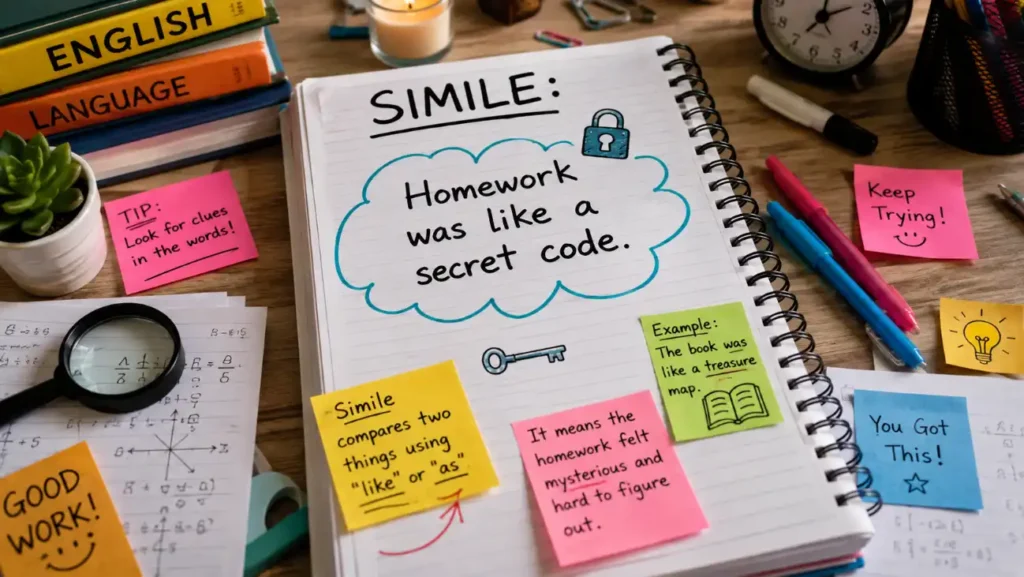
Meaning: Homework was difficult to understand at first.
Explanation: A secret code needs to be decoded. This comparison shows that the student had to figure out the meaning.
Examples:
- The math problem looked like a secret code.
- The instructions felt like a secret code at first.
46. Homework was as simple as one plus one
Meaning: Homework was extremely easy.
Explanation: One plus one is a very basic math problem, so this comparison emphasizes simplicity.
Examples:
- The worksheet was as simple as one plus one.
- Today’s homework was as simple as one plus one.
47. Homework was like a bridge
Meaning: Homework connected learning in class with practice at home.
Explanation: A bridge connects two places. Homework can connect classroom lessons with independent learning.
Examples:
- Homework was like a bridge between school and home.
- The practice sheet became a bridge to better understanding.
48. Homework was as refreshing as a cool breeze
Meaning: Homework felt enjoyable or satisfying.
Explanation: A cool breeze can feel pleasant and refreshing. This comparison gives homework a positive feeling.
Examples:
- Finishing my favorite writing task was as refreshing as a cool breeze.
- Solving the problem felt as refreshing as a cool breeze.
49. Homework was like a stepping stone
Meaning: Homework helps you move toward a goal.
Explanation: Stepping stones help people cross a path one step at a time. Homework can help students build skills gradually.
Examples:
- Each assignment was like a stepping stone toward success.
- My homework became a stepping stone to better grades.
50. Homework was as satisfying as reaching the finish line
Meaning: Finishing homework felt rewarding.
Explanation: Reaching a finish line means completing a race. This simile shows the satisfaction of completing an assignment.
Examples:
- Finishing my homework was as satisfying as reaching the finish line.
- Completing the final page felt as satisfying as crossing the finish line.
How to Use Similes in Homework Writing
Using a simile is simple. First, choose the thing you want to describe. Next, think about what it feels, looks, sounds, or acts like. Then, connect the two ideas with “like” or “as.”
For example:
Basic sentence:
My homework was difficult.
Simile sentence:
My homework was as difficult as climbing a mountain.
The second sentence gives the reader a stronger image.
You can also use similes to describe your emotions:
I felt like a runner racing against time.
Or you can describe the amount of work:
The homework was like an ocean of questions.
The key is to choose a comparison that makes sense and helps the reader imagine your idea.
Simile vs. Metaphor
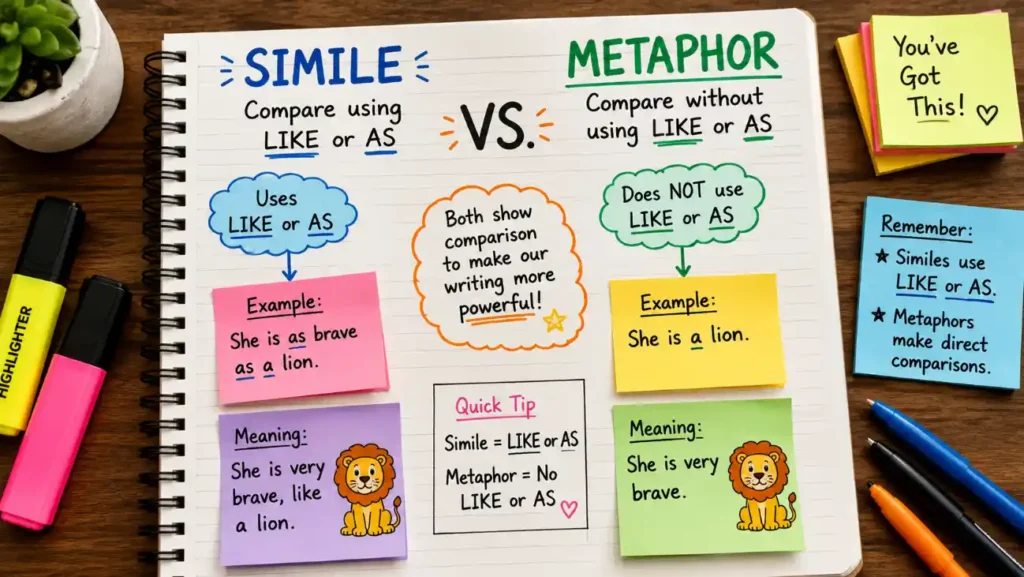
Similes and metaphors both compare things, but they work in different ways.
A simile usually uses “like” or “as.”
Example:
My homework was like a mountain.
A metaphor makes a direct comparison without using “like” or “as.”
Example:
My homework was about a mountain.
The two sentences have a similar meaning, but the grammar is different.
Here is another comparison:
- Simile: The homework was as confusing as a maze.
- Metaphor: The homework was a maze.
In simple terms, a simile says something is like another thing, while a metaphor says it is that thing.
Practical Exercise: Test Your Simile Skills
1. Complete the simile: My homework was as difficult as ________.
Answer: A mountain.
2. Which simile shows that homework was very easy: “like a puzzle” or “as simple as one plus one”?
Answer: As simple as one plus one.
3. Complete the sentence: My homework was like a ________ because I had to solve many problems.
Answer: Puzzle.
4. Which simile shows that homework took a long time?
A. Homework was like a quick flash.
B. Homework was like a long train ride.
Answer: B. Homework was like a long train ride.
5. Complete the simile: The instructions were as clear as ________.
Answer: Glass.
6. Which simile describes confusing homework: “as confusing as a maze” or “as light as a feather”?
Answer: As confusing as a maze.
7. Complete the simile: Finishing my homework was like reaching the ________.
Answer: Finish line.
8. Which simile shows that homework felt overwhelming?
A. Homework was like a mountain.
B. Homework was as light as a feather.
Answer: A. Homework was like a mountain.
9. Create your own simile for easy homework.
Answer: Example: My homework was as easy as eating pie.
10. Create your own simile for difficult homework.
Answer: Example: My homework was as tough as a rock.
Quick Tips for Creating Your Own Similes
You do not need complicated words to create a good simile. Start with a simple idea.
Ask yourself:
- What does my homework feel like?
- What does it look like?
- Does it remind me of something?
- Is it easy, hard, boring, exciting, or confusing?
- What object, animal, place, or activity shows that feeling?
For example, if homework feels difficult, you might write:
My homework was like climbing a steep mountain.
If it feels easy, you could write:
My homework was as light as a feather.
If it feels confusing, try:
My homework was like a maze with no map.
The best creative writing similes help readers see the idea in their minds.
Common Mistakes to Avoid
When writing similes, avoid comparisons that confuse your reader. The two things should have a clear connection.
For example:
Weak: My homework was like a purple sandwich.
This comparison may sound funny, but it does not clearly explain how the homework felt.
A stronger example is:
My homework was like a mountain because it seemed impossible to finish.
Also, do not add a simile to every sentence. Too many comparisons can make writing feel crowded. Instead, use them when they add a useful image or emotion.
Why Similes Make Student Writing Better
Similes can make student writing more vivid and memorable. Instead of giving readers only facts, they help readers imagine an experience.
Compare these two sentences:
My homework was hard.
My homework was like climbing a mountain in the rain.
The second sentence creates a picture. You can almost imagine the effort, frustration, and struggle.
That is why similes are useful in stories, poems, essays, journal entries, and creative writing assignments. They give ordinary sentences more personality.
Final Thoughts
Similes are a simple but powerful way to make writing more colorful. They allow you to compare homework with mountains, puzzles, roads, races, storms, and many other things. As a result, readers can understand not only what you mean but also how it feels.
If your homework is easy as pie, confusing as a maze, or heavy as a rock, there is always a creative way to describe it. The key is to choose a comparison that fits your idea.
So, next time you write a school assignment, try adding one or two creative writing similes. Start with something simple, use “like” or “as,” and let your imagination do the rest. With practice, writing similes will become easier, more natural, and much more fun.

I am Kate Messner inspires children through engaging stories and creativity, while Publivexa.com helps students learn similes, vocabulary, writing skills, and English concepts with confidence.