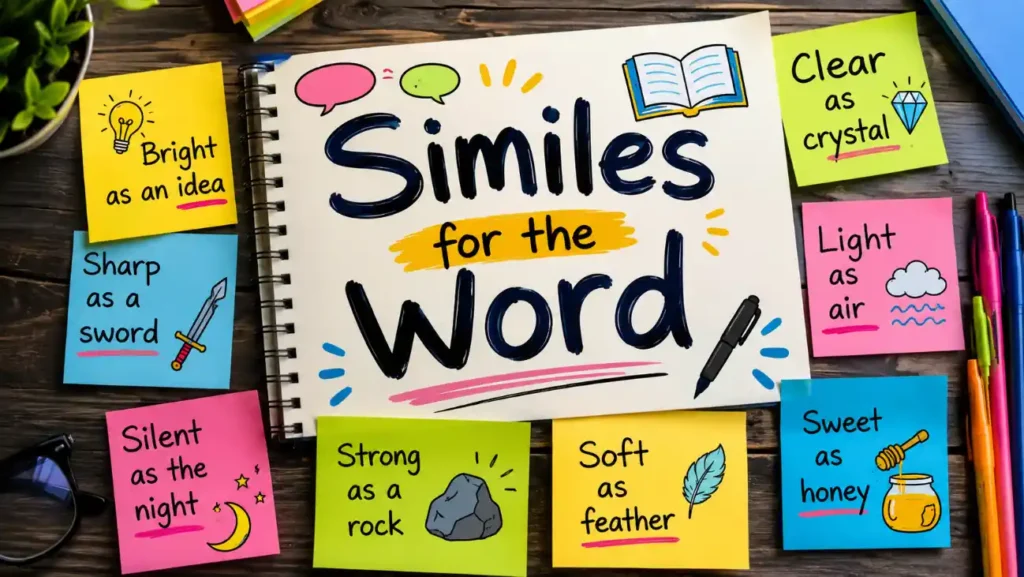
Have you ever searched for the right word but felt that a plain description was not enough? That is where a good simile can help. Similes for the word can make your writing more colorful, clear, and fun to read. They compare one thing with another by using words such as “like” or “as.”
For example, you might say, “Her words were like sunshine after a rainy day.” This gives the reader more than a basic description. It helps them picture the feeling.
In simple terms, a simile turns an ordinary idea into an image that readers can understand. Writers use creative writing similes in stories, poems, essays, speeches, and everyday conversations.
So, let’s explore 50 simile examples that show different ways to describe a word. Each example includes its meaning, a simple explanation, and two useful simile sentences. By the end, you will also learn how to create your own.
What Is a Simile?
A simile is a figure of speech that compares two different things using “like” or “as.”
For example:
Her words were like arrows.
The words are not really arrows. The comparison shows that they were sharp, powerful, or hurtful.
In other words, similes help readers form a picture in their minds. They also make writing more emotional and memorable.
50 Similes for the Word
Below are 50 creative examples you can use when describing a word, words, speech, language, message, or expression.
1. A Word Like a Spark
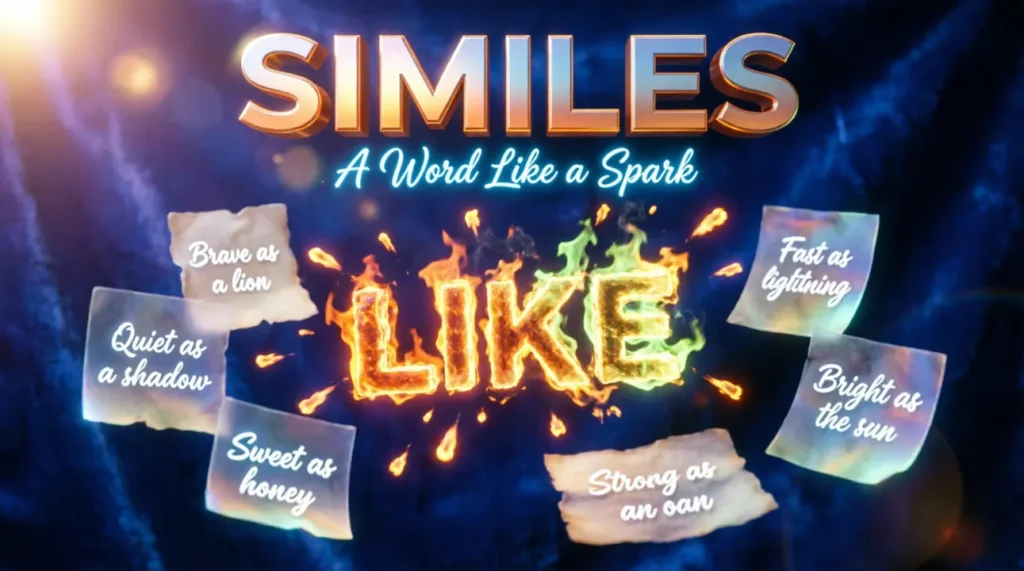
Meaning: A word can be small but powerful.
Explanation: This simile shows how one simple word can start an idea, feeling, or action.
Her kind words were like a spark in a dark room.
One brave word was like a spark that started a new idea.
2. A Word Like Sunshine
Meaning: A word can bring happiness and hope.
Explanation: This comparison suggests that a positive word can brighten someone’s mood.
Her compliment was like sunshine on a cloudy morning.
His kind words felt like sunshine after a difficult day.
3. A Word Like an Arrow
Meaning: A word can be sharp and powerful.
Explanation: This simile shows that words can reach people quickly and leave a strong emotional impact.
His angry words were like an arrow aimed at my heart.
That cruel word struck me like an arrow.
4. A Word Like a Whisper
Meaning: A word can be soft and quiet.
Explanation: This comparison creates a gentle image of someone speaking in a low or careful voice.
Her name floated through the room like a whisper.
The final word sounded like a whisper in the silence.
5. A Word Like a Bell
Meaning: A word can be clear and noticeable.
Explanation: This simile suggests that the word stands out and catches everyone’s attention.
His warning rang out like a bell.
The important word sounded like a bell in my mind.
6. A Word Like a Knife
Meaning: A word can hurt deeply.
Explanation: This comparison shows that harsh language can cause emotional pain.
Her insult cut like a knife.
That careless word felt like a knife to him.
7. A Word Like a Feather
Meaning: A word can feel light and gentle.
Explanation: This simile describes soft language that causes little emotional pressure.
Her apology landed like a feather.
The gentle word floated into the conversation like a feather.
8. A Word Like a Wave
Meaning: A word can create a strong emotional movement.
Explanation: This comparison suggests that words can wash over people and change how they feel.
His message came like a wave of hope.
Her words moved through the crowd like a wave.
9. A Word Like a Key
Meaning: A word can unlock an idea or feeling.
Explanation: This simile shows how the right word can help someone understand something.
That simple word was like a key to the mystery.
Her question worked like a key that opened his mind.
10. A Word Like a Door
Meaning: A word can create a new opportunity.
Explanation: This comparison shows that language can lead to new thoughts, choices, or possibilities.
His final word was like a door opening to a new future.
That sentence felt like a door into another world.
11. A Word Like a Flame
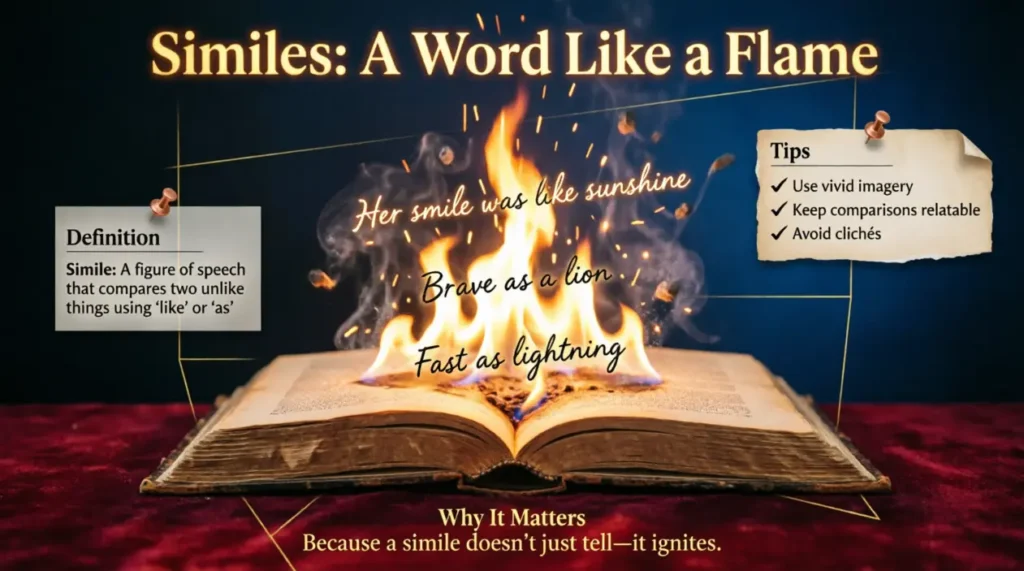
Meaning: A word can create passion or excitement.
Explanation: This simile suggests that strong language can awaken energy inside people.
Her speech burned like a flame.
One powerful word spread like a flame through the crowd.
12. A Word Like Rain
Meaning: A word can feel calming or refreshing.
Explanation: This comparison works well for peaceful, comforting, or healing language.
His advice fell like rain on my worried mind.
Her gentle words came like rain after a long dry season.
13. A Word Like Thunder
Meaning: A word can be loud and powerful.
Explanation: This simile shows that certain words can command attention.
His warning crashed like thunder across the room.
The final word sounded like thunder.
14. A Word Like Ice
Meaning: A word can feel cold or unfriendly.
Explanation: This comparison describes language that lacks warmth or kindness.
Her reply was like ice against his cheerful mood.
That cold word felt like ice in the conversation.
15. A Word Like Honey
Meaning: A word can be sweet and pleasant.
Explanation: This simile describes kind or flattering language that feels enjoyable to hear.
Her praise was like honey to his ears.
His sweet words flowed like honey.
16. A Word Like a Mirror
Meaning: A word can reveal someone’s thoughts or feelings.
Explanation: This comparison shows how language can reflect what is happening inside a person.
His answer was like a mirror of his true feelings.
Every word became like a mirror showing her emotions.
17. A Word Like a Bridge
Meaning: A word can connect people.
Explanation: This simile shows that communication can bring people closer together.
Her apology was like a bridge between the two friends.
One honest word became like a bridge across their disagreement.
18. A Word Like a Seed
Meaning: A word can grow into a larger idea.
Explanation: This comparison suggests that a small statement can develop into something meaningful over time.
His suggestion was like a seed planted in my mind.
That single word grew like a seed into a great idea.
19. A Word Like a Star
Meaning: A word can stand out in a dark or difficult moment.
Explanation: This simile creates an image of guidance, hope, or beauty.
Her hopeful words were like a star in the darkness.
That message shone like a star during a hard time.
20. A Word Like a Drumbeat
Meaning: A word can be strong and repeated.
Explanation: This comparison works well when a message stays in someone’s mind.
His advice returned like a drumbeat in my thoughts.
The same word echoed like a drumbeat all day.
21. A Word Like a Feather in the Wind
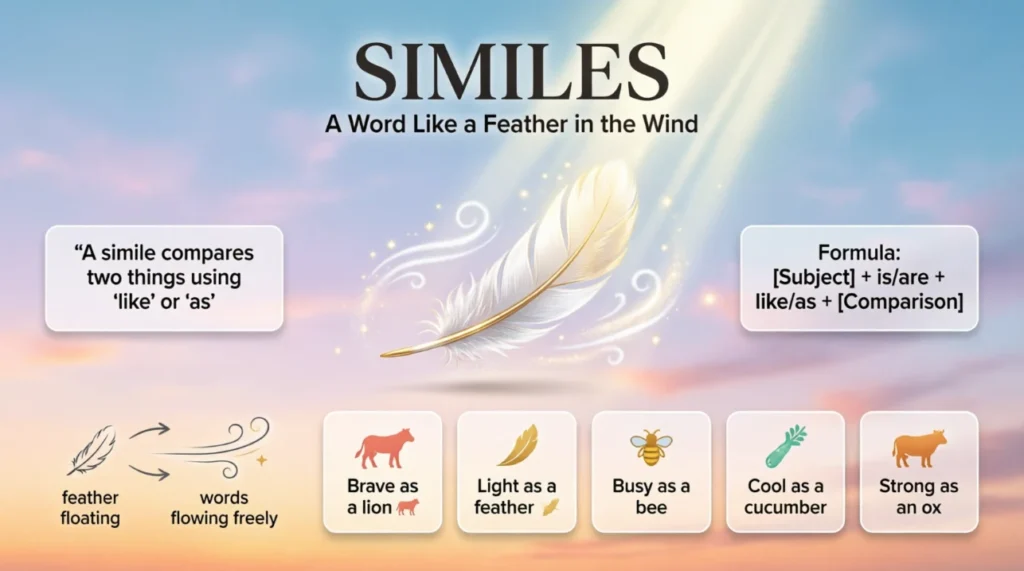
Meaning: A word can disappear quickly.
Explanation: This simile describes words that are easily forgotten or ignored.
His promise vanished like a feather in the wind.
The careless word drifted away like a feather in the wind.
22. A Word Like a Mountain
Meaning: A word can carry great weight.
Explanation: This comparison shows that one word may feel extremely important.
Her final answer stood like a mountain before him.
That promise felt like a mountain of responsibility.
23. A Word Like a River
Meaning: Words can flow continuously.
Explanation: This simile is useful for describing someone who speaks smoothly and without stopping.
His ideas flowed like a river.
Her words moved like a river through the story.
24. A Word Like a Puzzle Piece
Meaning: A word can complete an idea.
Explanation: This comparison shows that the right word can make something suddenly clear.
That final term fits like a puzzle piece.
Her explanation was like a puzzle piece missing from my understanding.
25. A Word Like a Lantern
Meaning: A word can provide guidance.
Explanation: This simile shows how language can help someone find direction.
His advice was like a lantern in the darkness.
One encouraging word became like a lantern on her difficult journey.
26. A Word Like a Feather Touch
Meaning: A word can be gentle and delicate.
Explanation: This comparison works well for soft, caring, or sensitive language.
Her comforting words felt like a feather touch.
The apology came like a feather touch to his sadness.
27. A Word Like a Drum
Meaning: A word can have a strong effect.
Explanation: This simile suggests that language can make an idea feel powerful and noticeable.
His message beat like a drum in everyone’s minds.
The warning sounded like a drum before the storm.
28. A Word Like a Rose
Meaning: A word can be beautiful but still carry pain.
Explanation: This comparison highlights the beauty and possible danger of language.
Her compliment was like a rose with hidden thorns.
That beautiful word was like a rose that still carried pain.
29. A Word Like a Cage
Meaning: A word can limit someone.
Explanation: This simile shows that labels or harsh descriptions can make people feel trapped.
That unfair label was like a cage.
His negative words became like a cage around her confidence.
30. A Word Like a Compass
Meaning: A word can guide someone.
Explanation: This comparison is useful for advice, encouragement, or direction.
Her advice was like a compass when I felt lost.
That simple word worked like a compass for his decision.
31. A Word Like a Rocket
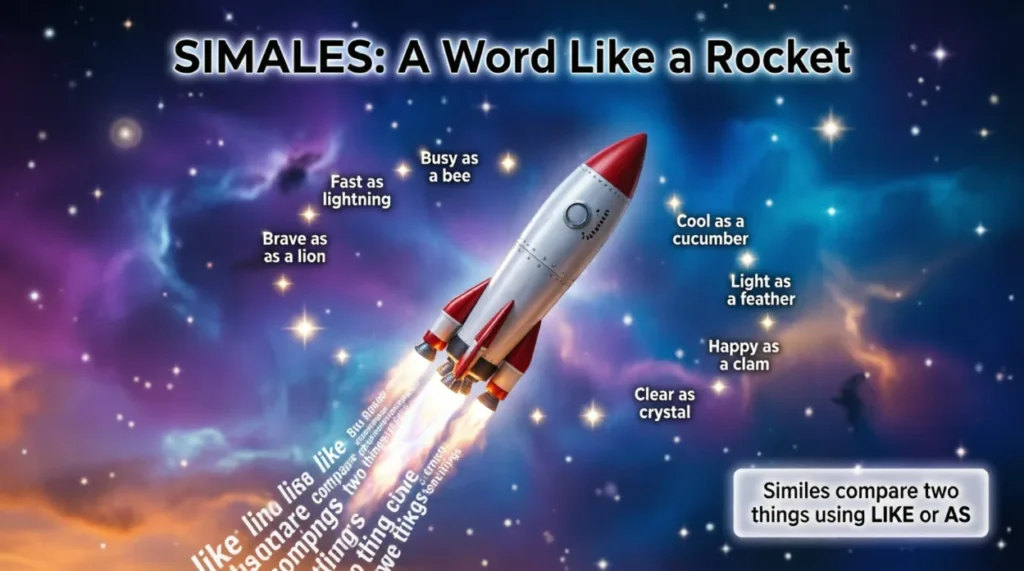
Meaning: A word can move quickly and create excitement.
Explanation: This simile shows how a statement can spread fast or inspire sudden action.
The exciting announcement traveled like a rocket.
One catchy word spread like a rocket online.
32. A Word Like a Shadow
Meaning: A word can stay with someone.
Explanation: This comparison describes language that people remember long after hearing it.
His warning followed me like a shadow.
That painful word stayed like a shadow in her memory.
33. A Word Like a Lock
Meaning: A word can prevent communication.
Explanation: This simile shows how certain words can stop people from opening up.
His angry response was like a lock on the conversation.
That harsh word became like a lock between them.
34. A Word Like a Candle
Meaning: A word can bring comfort and hope.
Explanation: This comparison creates a warm image of language helping someone through a difficult moment.
Her message was like a candle in the darkness.
His kind words burned like a candle during my hardest night.
35. A Word Like a Drumroll
Meaning: A word can create suspense.
Explanation: This simile works well when a word builds excitement before something important happens.
The final word arrived like a drumroll before the announcement.
Her name appeared like a drumroll before the winner was revealed.
36. A Word Like a Storm
Meaning: A word can create emotional chaos.
Explanation: This comparison describes language that causes anger, confusion, or strong reactions.
His accusation hit like a storm.
The angry words arrived like a storm.
37. A Word Like a Butterfly
Meaning: A word can be beautiful and delicate.
Explanation: This simile creates an image of language that feels graceful and light.
Her poetic phrase moved like a butterfly.
The beautiful word floated like a butterfly through the poem.
38. A Word Like a Hammer
Meaning: A word can deliver a strong impact.
Explanation: This comparison shows how direct language can hit hard.
His criticism landed like a hammer.
The truth struck like a hammer.
39. A Word Like a Map
Meaning: A word can help explain where to go.
Explanation: This simile works well for advice, instructions, or helpful information.
Her instructions were like a map.
That simple explanation became like a map for the students.
40. A Word Like a Puzzle
Meaning: A word can be difficult to understand.
Explanation: This comparison describes language that needs thought before its meaning becomes clear.
His strange statement was like a puzzle.
The final clue made the difficult word feel like a puzzle solved.
41. A Word Like a Doorbell
Meaning: A word can get someone’s attention.
Explanation: This simile shows how a surprising or important word can make people stop and listen.
The announcement sounded like a doorbell in the quiet room.
That unusual word rang like a doorbell in my mind.
42. A Word Like a Drumbeat in the Heart
Meaning: A word can create a deep emotional response.
Explanation: This comparison describes language that feels personal and powerful.
Her name echoed like a drumbeat in my heart.
His final message returned like a drumbeat in her heart.
43. A Word Like a Firework
Meaning: A word can be exciting and surprising.
Explanation: This simile works well for dramatic, clever, or unexpected language.
His joke exploded like a firework.
The final word was like a firework in the conversation.
44. A Word Like a Photograph
Meaning: A word can create a clear mental picture.
Explanation: This comparison shows how descriptive language helps readers visualize something.
Her description was like a photograph.
The writer’s words painted the scene like a photograph in my mind.
45. A Word Like a Rope
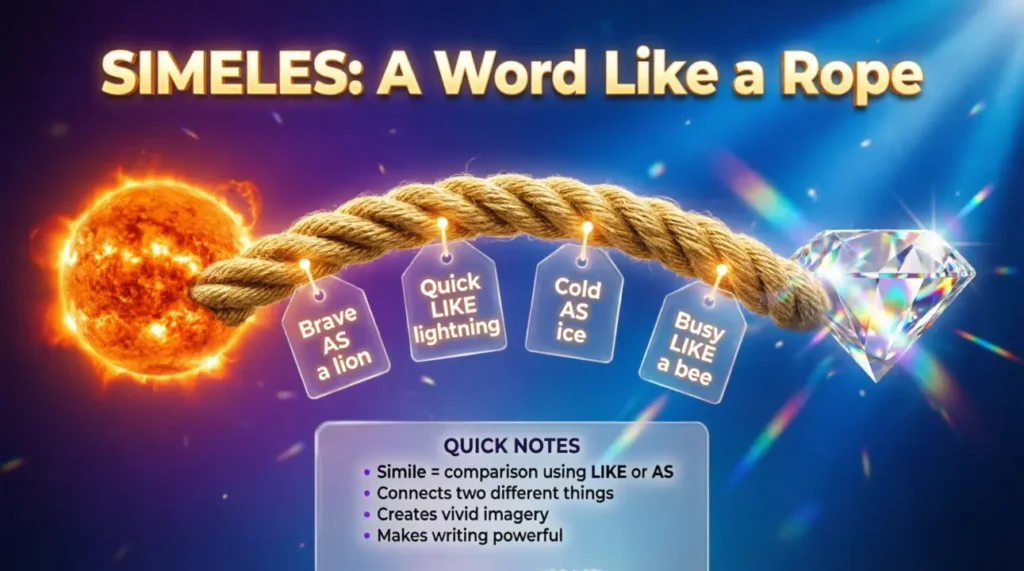
Meaning: A word can help someone hold on.
Explanation: This simile describes encouraging language that gives emotional support.
His promise was like a rope during a difficult climb.
Her encouraging words felt like a rope when I wanted to give up.
46. A Word Like a Drum in the Distance
Meaning: A word can create a feeling of approaching change.
Explanation: This comparison works well when a message hints that something important is coming.
The warning sounded like a drum in the distance.
His prediction felt like a drum in the distance before the change.
47. A Word Like a Window
Meaning: A word can give us a new view.
Explanation: This simile shows how language can help people see an idea from another perspective.
Her explanation was like a window into her world.
That new word opened like a window to a different idea.
48. A Word Like a Stone
Meaning: A word can feel heavy.
Explanation: This comparison describes words that carry sadness, guilt, anger, or serious meaning.
His apology felt like a stone in his chest.
The final word dropped like a stone into the silence.
49. A Word Like a Song
Meaning: A word can sound beautiful and memorable.
Explanation: This simile is useful for poetic, musical, or pleasant language.
Her name sounded like a song.
Every word in the poem flowed like a song.
50. A Word Like a Sunrise
Meaning: A word can bring a fresh beginning.
Explanation: This comparison shows how hopeful language can make someone feel ready for a new start.
His message was like a sunrise after a dark night.
Her final word felt like a sunrise over a new beginning.
Simile vs. Metaphor
Similes and metaphors both make writing more creative, but they work in different ways.
A simile makes a comparison using “like” or “as.”
Simile: Her words were like sunshine.
A metaphor makes a direct comparison without using “like” or “as.”
Metaphor: Her words were sunshine.
In simple terms, a simile says that one thing is like another. A metaphor says that one thing is another.
For example:
- Simile: His words were like arrows.
- Metaphor: His words were arrows.
- Simile: Her voice was like music.
- Metaphor: Her voice was music.
Both can make your writing strong. However, similes are often easier for beginners because the comparison is clear.
How to Use Similes in Writing
Using similes does not have to be difficult. Start by thinking about the feeling or quality you want to describe.
For example, if a word is kind, ask yourself:
What else feels kind?
You might think of sunshine, a warm blanket, or a gentle breeze.
Then create your comparison:
Her words were like warm sunshine.
You can also think about the five senses. Ask what the word sounds, feels, looks, or even tastes like.
For example:
- A sweet word can be like honey.
- A painful word can be like a knife.
- A powerful word can be like thunder.
- A hopeful word can be like a sunrise.
The best examples of similes do more than decorate a sentence. They help the reader feel or see the idea.
Practical Exercise: Test Your Simile Skills
Try these 10 questions before checking the answers.
1. Complete the simile: Her kind words were like ________.
Answer: sunshine
2. Which simile suggests that words can hurt deeply?
Answer: His words were like a knife.
3. Complete the simile: His advice was like a ________ when I felt lost.
Answer: compass
4. Which sentence is a simile?
Answer: Her voice was like music.
5. Complete the simile: The warning sounded like ________.
Answer: thunder
6. Which comparison suggests that words can connect people?
Answer: Her apology was like a bridge.
7. Is this a simile or metaphor: “His words were arrows”?
Answer: Metaphor
8. Complete the simile: Her beautiful words floated like a ________.
Answer: butterfly
9. Which simile shows that a word can provide hope?
Answer: His advice was like a lantern in the darkness.
10. Create your own simile using the word “kind.”
Answer: One possible answer is: “Her kind words were like warm sunshine.” Other creative answers can also be correct.
Why Are Similes Important?
Similes make simple writing more vivid. Instead of telling readers that something is “beautiful,” “sad,” “strong,” or “kind,” you can show them what that feeling looks like.
For example, compare these sentences:
Her words were kind.
Her words were like sunshine after a storm.
The second sentence creates a stronger picture.
That is the real power of simile sentences. They give readers something they can imagine. As a result, your writing can become easier to understand and more enjoyable to read.
If you are writing a story, poem, school assignment, or social post, a well-chosen comparison can make your words stand out.
Tips for Creating Your Own Similes
You can create original similes with a few simple steps.
First, choose the idea. Decide what you want to describe.
Next, choose its quality. Is it soft, loud, sweet, powerful, cold, bright, or mysterious?
Then, find something familiar. Think of an object, animal, place, sound, or natural event with the same quality.
Finally, connect them with “like” or “as.”
For example:
Idea: A powerful word
Quality: Strong
Comparison: Thunder
Simile: His words were like thunder.
You might also experiment with unusual comparisons. A fresh comparison can make your writing more memorable.
Final Thoughts
Similes give ordinary words a stronger voice. They help readers picture an idea instead of simply reading about it. As we explored, a word can be compared to sunshine, thunder, a bridge, a seed, a lantern, or even a sunrise.
The key is to choose a comparison that matches the feeling you want to create. In addition, keep your similes clear and natural. You do not need complicated language to make creative writing powerful.
So, the next time you write a story, poem, essay, or description, try adding one simple simile. Ask yourself, “What is this idea like?” You may discover that one creative comparison can completely change your sentence.

I am Kate Messner inspires children through engaging stories and creativity, while Publivexa.com helps students learn similes, vocabulary, writing skills, and English concepts with confidence.