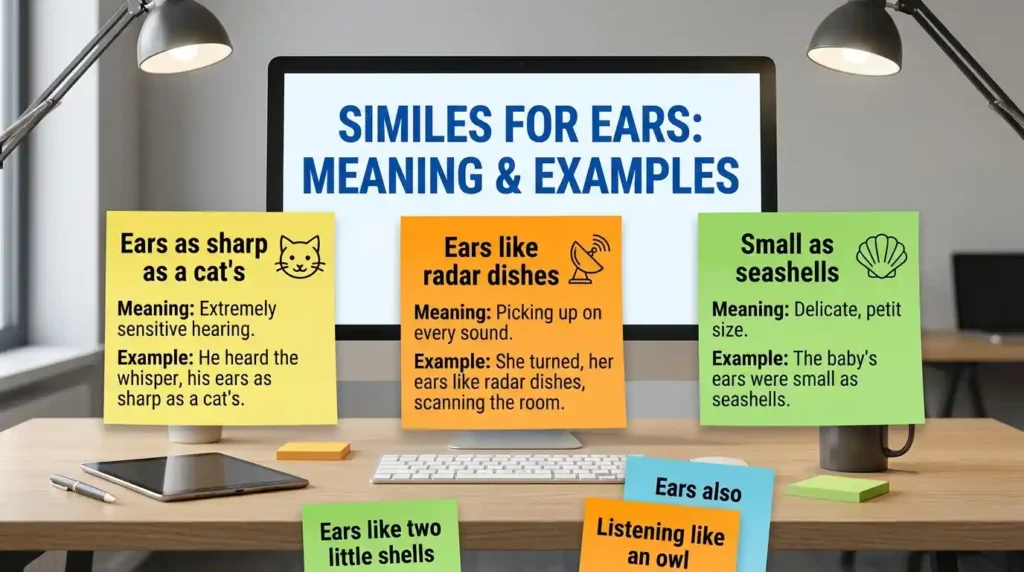
Have you ever wanted to describe someone’s ears in a more colorful way? Saying “He has big ears” is clear, but it does not give your reader much to imagine. A simile can change that. Similes for ears help you compare ears to familiar things, such as shells, flowers, leaves, wings, or even tiny cups.
A simile usually uses words such as like or as to make a comparison. For example, “Her ears were like tiny shells” helps us picture their shape. In simple terms, a good simile turns an ordinary description into a small picture in the reader’s mind.
You can use creative writing similes in stories, poems, school assignments, character descriptions, and everyday writing. The best ones do more than describe appearance. They can also show personality, emotion, size, shape, or how well someone listens.
So, let’s explore 50 similes for ears, with simple meanings, explanations, and two simile sentences for each one.
50 Similes for Ears
1. Ears Like Tiny Shells
Meaning: The ears are curved and delicate like small seashells.
Explanation: This simile creates a gentle image and works well when describing small or pretty ears.
Examples:
- Her ears were like tiny shells beside her dark hair.
- The baby had ears like tiny shells.
2. Ears Like Little Cups
Meaning: The ears look like small cups that can catch sound.
Explanation: This comparison focuses on the shape of the ears and their ability to receive sounds.
Examples:
- His ears stuck out like little cups.
- The child held his ears like little cups toward the music.
3. Ears Like Soft Petals
Meaning: The ears are soft and delicate like flower petals.
Explanation: This simile gives the description a gentle and beautiful feeling.
Examples:
- Her ears were as soft as petals.
- The little girl had ears like soft petals.
4. Ears Like Open Flowers
Meaning: The ears have a rounded shape that resembles an open flower.
Explanation: This comparison makes the ears sound graceful and natural.
Examples:
- His ears looked like open flowers against his hair.
- Her small ears were like open flowers.
5. Ears Like Tiny Fans
Meaning: The ears spread outward like small fans.
Explanation: Use this simile when you want to highlight ears that stick out from the head.
Examples:
- His ears opened like tiny fans.
- The puppy had ears like tiny fans.
6. Ears Like Little Wings
Meaning: The ears stick out or spread sideways like wings.
Explanation: This creates a playful image, especially when describing a child or animal.
Examples:
- His ears stood out like little wings.
- The puppy’s ears moved like little wings.
7. Ears Like Pink Petals
Meaning: The ears look soft and pink like flower petals.
Explanation: This simile focuses on both color and softness.
Examples:
- Her ears were like pink petals beneath her hair.
- The baby’s ears looked like pink petals.
8. Ears Like Velvet
Meaning: The ears feel or appear smooth and soft.
Explanation: Velvet is known for its soft texture, so this comparison creates a cozy image.
Examples:
- His ears felt as soft as velvet.
- The kitten had ears like velvet.
9. Ears Like Two Little Boats
Meaning: The ears have a curved shape that resembles small boats.
Explanation: This is a playful simile that works especially well in children’s writing.
Examples:
- His ears looked like two little boats.
- The child’s ears curved like little boats beside his head.
10. Ears Like Crescent Moons
Meaning: The ears have a curved shape similar to a crescent moon.
Explanation: This comparison gives a poetic feeling to an ordinary description.
Examples:
- Her ears curved like crescent moons.
- The artist drew ears like tiny crescent moons.
11. Ears Like Small Fans
Meaning: The ears spread outward like fans.
Explanation: This simile is useful when describing large or prominent ears.
Examples:
- His ears stuck out like small fans.
- The rabbit had ears that opened like small fans.
12. Ears Like Delicate Leaves
Meaning: The ears are thin and delicate like leaves.
Explanation: This gives the reader an image of light, soft, and natural ears.
Examples:
- Her ears were as delicate as leaves.
- The baby’s ears looked like delicate leaves.
13. Ears Like Little Roses
Meaning: The ears are small, rounded, or pink like roses.
Explanation: This creates a sweet and attractive image.
Examples:
- Her ears were like little roses beside her cheeks.
- The baby’s ears looked like tiny roses.
14. Ears Like Tiny Petals
Meaning: The ears look soft and small like flower petals.
Explanation: This simile is useful for gentle character descriptions.
Examples:
- His little ears were like tiny petals.
- She had ears as delicate as tiny petals.
15. Ears Like Two Satellites
Meaning: The ears seem to stick out and receive sounds from different directions.
Explanation: This playful comparison connects ears with objects that receive signals.
Examples:
- His ears looked like two satellites searching for sound.
- Her ears stood out like little satellites.
16. Ears Like Radar Dishes
Meaning: The ears seem large and ready to catch every sound.
Explanation: Radar dishes are designed to receive signals, making this a funny comparison for excellent listeners.
Examples:
- His ears worked like radar dishes during the secret meeting.
- She turned her ears like radar dishes toward the noise.
17. Ears Like Listening Cups
Meaning: The ears seem shaped to catch sounds.
Explanation: This simile highlights the basic job of ears in a simple way.
Examples:
- His ears were like listening cups.
- She raised her head, her ears like listening cups.
18. Ears Like Little Spoons
Meaning: The ears have a curved shape similar to small spoons.
Explanation: This is a fun and simple comparison for creative descriptions.
Examples:
- The baby had ears like little spoons.
- His ears curved like two little spoons.
19. Ears Like Curved Petals
Meaning: The ears are curved and delicate like petals.
Explanation: This simile combines shape and softness.
Examples:
- Her ears were like curved petals.
- The fairy had ears like curved petals.
20. Ears Like Tiny Bowls
Meaning: The ears look rounded and slightly hollow.
Explanation: This comparison emphasizes the bowl-like shape of the outer ear.
Examples:
- His ears looked like tiny bowls.
- The child’s ears curved like tiny bowls.
21. Ears Like Little Mountains
Meaning: The ears rise from the sides of the head like small mountains.
Explanation: This is a playful way to describe ears that stand out.
Examples:
- His ears rose like little mountains above his collar.
- The cartoon character had ears like little mountains.
22. Ears Like Two Leaves
Meaning: The ears are thin, light, or flat like leaves.
Explanation: This creates a natural and gentle image.
Examples:
- Her ears moved like two leaves in the wind.
- The fairy had ears like two delicate leaves.
23. Ears Like Soft Feathers
Meaning: The ears appear or feel extremely soft.
Explanation: Feathers suggest lightness and softness, making this a gentle comparison.
Examples:
- The kitten’s ears were soft like feathers.
- Her ears looked as delicate as soft feathers.
24. Ears Like Tiny Windows
Meaning: The ears seem like small openings that let sounds enter.
Explanation: This creative simile focuses on the way ears receive information from the world.
Examples:
- His ears were like tiny windows to the world.
- She kept her ears open like tiny windows.
25. Ears Like Little Antennas
Meaning: The ears seem ready to pick up every sound.
Explanation: Antennas receive signals, so this is a fun way to describe someone who notices every noise.
Examples:
- His ears were like little antennas.
- She had ears like antennas whenever someone whispered.
26. Ears Like Two Radios
Meaning: The ears seem to pick up sounds from all around.
Explanation: This humorous comparison works well for someone who hears everything.
Examples:
- His ears were like two radios tuned to every sound.
- Grandma’s ears seemed like two radios.
27. Ears Like Tiny Drums
Meaning: The ears are connected with the idea of hearing and sound.
Explanation: Drums make sounds, so this simile can create a lively sound-related image.
Examples:
- His ears seemed like tiny drums during the concert.
- Her ears caught the beat like tiny drums.
28. Ears Like Open Doors
Meaning: The ears are always ready to receive sounds or information.
Explanation: This comparison can describe someone who listens carefully.
Examples:
- Her ears were like open doors for every new story.
- He listened with ears like open doors.
29. Ears Like Curious Antennas
Meaning: The ears seem eager to catch every sound.
Explanation: This works especially well for curious children or characters.
Examples:
- The boy’s ears stood like curious antennas.
- Her ears seemed like curious antennas during the conversation.
30. Ears Like Tiny Catcher’s Mitts
Meaning: The ears seem to catch sounds like mitts catch balls.
Explanation: This playful simile makes the act of hearing easy to imagine.
Examples:
- His ears were like tiny catcher’s mitts for every sound.
- She used her ears like tiny catcher’s mitts.
31. Ears Like Listening Flowers
Meaning: The ears seem open and ready to receive sounds.
Explanation: This poetic comparison combines nature with the idea of listening.
Examples:
- Her ears opened like listening to flowers.
- The child sat quietly with ears like listening to flowers.
32. Ears Like Two Little Shells
Meaning: The ears are curved and shell-like.
Explanation: Shells are a classic comparison because of their curved shape.
Examples:
- His ears looked like two little shells.
- She had ears like two little seashells.
33. Ears Like Curved Ribbons
Meaning: The ears have a soft, curved shape.
Explanation: This gives the description a graceful and artistic feeling.
Examples:
- Her ears curved like ribbons.
- The elf had ears like curved ribbons.
34. Ears Like Tiny Butterflies
Meaning: The ears appear delicate and spread outward.
Explanation: This playful comparison creates a light and imaginative image.
Examples:
- His ears stuck out like tiny butterflies.
- The character had ears like tiny butterflies.
35. Ears Like Small Clouds
Meaning: The ears look soft, rounded, or fluffy.
Explanation: Clouds suggest softness and lightness.
Examples:
- The puppy had ears like small clouds.
- Her soft ears looked like little clouds.
36. Ears Like Soft Cushions
Meaning: The ears appear very soft and comfortable.
Explanation: Cushions are associated with softness, making this a simple descriptive simile.
Examples:
- The puppy’s ears felt like soft cushions.
- His ears looked as soft as little cushions.
37. Ears Like Tiny Flags
Meaning: The ears stick upward or outward like flags.
Explanation: This is a playful way to describe ears that move or stand out.
Examples:
- The dog’s ears stood like tiny flags.
- His ears rose like little flags when he heard his name.
38. Ears Like Little Sails
Meaning: The ears spread outward like sails catching wind.
Explanation: This comparison is especially useful for large or pointed ears.
Examples:
- The rabbit’s ears rose like little sails.
- His ears opened like sails in the breeze.
39. Ears Like Bright Petals
Meaning: The ears look soft, colorful, or delicate.
Explanation: This poetic simile can add beauty to a character description.
Examples:
- Her ears showed like bright petals beneath her hair.
- The fairy’s ears looked like bright petals.
40. Ears Like Tiny Gates
Meaning: The ears seem like openings through which sounds enter.
Explanation: This comparison focuses on the function of hearing.
Examples:
- His ears were like tiny gates to the noisy world.
- She kept her ears open like tiny gates.
41. Ears Like Curious Little Doors
Meaning: The ears seem ready to open to every new sound.
Explanation: This playful simile works well when describing a curious listener.
Examples:
- Her ears were like curious little doors.
- The child listened with ears like little doors.
42. Ears Like Silver Hooks
Meaning: The ears have a curved or hooked appearance.
Explanation: This simile can describe pointed or unusually curved ears in fantasy writing.
Examples:
- The elf had ears like silver hooks.
- His pointed ears curved like silver hooks.
43. Ears Like Pointed Leaves
Meaning: The ears are pointed and shaped somewhat like leaves.
Explanation: This works especially well for animals, elves, or fantasy characters.
Examples:
- The fox had ears like pointed leaves.
- Her elf ears rose like pointed leaves.
44. Ears Like Rabbit Wings
Meaning: The ears are large, upright, and spread outward.
Explanation: This playful comparison is useful for describing animals or cartoon characters.
Examples:
- The rabbit’s ears stood like little wings.
- His ears rose like rabbit wings.
45. Ears Like Listening Satellites
Meaning: The ears seem to pick up sounds from far away.
Explanation: This humorous simile is perfect for someone who notices every little noise.
Examples:
- His ears worked like listening satellites.
- She had listening satellites instead of ordinary ears.
46. Ears Like Sound Catchers
Meaning: The ears seem designed to catch every sound.
Explanation: This direct and creative comparison makes hearing easy to picture.
Examples:
- His ears were like sound catchers.
- She turned her sound catchers toward the music.
47. Ears Like Tiny Megaphones
Meaning: The ears look large or seem to make sounds easier to notice.
Explanation: This funny comparison can work in humorous character descriptions.
Examples:
- His ears looked like tiny megaphones.
- The cartoon boy had ears like little megaphones.
48. Ears Like Two Curious Birds
Meaning: The ears seem alert and ready to notice sounds.
Explanation: This gives the character an energetic and playful quality.
Examples:
- Her ears seemed like two curious birds.
- His ears perked up like two curious birds.
49. Ears Like Little Watchtowers
Meaning: The ears seem alert and ready to notice everything.
Explanation: Watchtowers are used to observe what is happening, so this simile suggests strong awareness.
Examples:
- His ears stood like little watchtowers.
- The guard listened with ears like watchtowers.
50. Ears Like Two Tiny Antennas in the Wind
Meaning: The ears seem alert, active, and ready to catch every sound.
Explanation: This imaginative simile combines movement and hearing. It works well in playful stories and creative descriptions.
Examples:
- His ears moved like two tiny antennas in the wind.
- The puppy’s ears stood like two tiny antennas in the wind.
How to Use Similes for Ears in Writing
A simile becomes more useful when it fits the scene. You do not need to add a fancy comparison to every sentence. Instead, choose one that helps your reader see, feel, or understand the character.
For example, if you are writing about a baby, “Her ears were like tiny shells” creates a soft image. On the other hand, a funny character might have “ears like little antennas.”
You can also use similes to show personality. Someone who hears everything might have “ears like radar dishes.” A fantasy character could have “ears like pointed leaves.”
In simple terms, ask yourself three questions:
- What do the ears look like?
- What feeling should the description create?
- What familiar object matches that idea?
Then choose a comparison that feels natural.
Practical Exercise
Try these questions before looking at the answers. They can help you practice identifying and creating simile sentences.
1. Complete the sentence:
Her ears were as soft as ________.
Answer:
Her ears were as soft as velvet.
2. Which word often signals a simile?
A. Because
B. Like
C. Before
D. While
Answer:
B. Like
3. Complete the sentence:
His ears stood out like ________.
Answer:
His ears stood out like tiny fans.
4. Is this a simile?
Her ears were tiny shells.
Answer:
No. It is a direct comparison without “like” or “as.” A simile would be: “Her ears were like tiny shells.”
5. Create a simile for large ears.
Answer:
His ears were like two little fans.
6. Create a simile for delicate ears.
Answer:
Her ears were as delicate as flower petals.
7. Which simile sounds playful?
A. His ears were like little antennas.
B. His ears were ears.
Answer:
A. His ears were like little antennas.
8. Complete the sentence:
The elf had ears like ________.
Answer:
The elf had ears like pointed leaves.
9. What does “ears like radar dishes” suggest?
Answer:
It suggests that someone is very good at hearing or notices sounds from far away.
10. Write your own simile for ears using “as.”
Answer:
Her ears were as soft as feathers.
Conclusion
Similes make simple descriptions more vivid, memorable, and fun. Instead of simply saying that someone has small, large, soft, or pointed ears, you can give your reader a clear picture with a creative comparison.
For example, “Her ears were like tiny shells” feels more visual than simply saying “Her ears were small.” That is the power of creative writing similes.
When you write your own similes, think about shape, size, color, texture, movement, and personality. Then look for something familiar that matches your idea. You might say ears are like flowers, shells, leaves, antennas, or tiny cups.
Most importantly, do not be afraid to experiment. The more simile sentences you create, the easier it becomes to make your writing colorful and interesting.

I am Kate Messner inspires children through engaging stories and creativity, while Publivexa.com helps students learn similes, vocabulary, writing skills, and English concepts with confidence.