
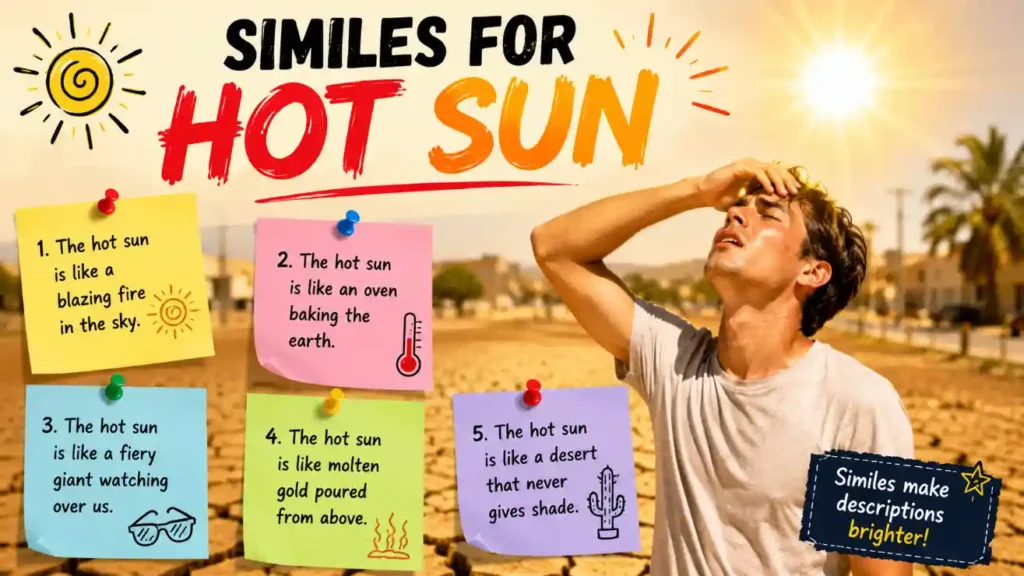
Have you ever walked outside on a summer afternoon and felt like the sun was following you? The heat can feel so strong that even a short walk seems exhausting. Instead of simply saying, “The sun was hot,” you can make your writing more vivid with similes for hot sun.
A simile compares two different things using words such as like or as. For example, you might say, “The sun was like a blazing fire.” This gives the reader a stronger picture of the heat.
In simple terms, similes help readers see, feel, and imagine what you describe. They can make stories, poems, essays, and school assignments much more interesting.
So, let’s explore 50 similes for the hot sun. Each one includes its meaning, a simple explanation, and two example sentences. You will also find a practical exercise at the end, with every question followed immediately by its answer.
50 Similes for Hot Sun
1. The sun was like a blazing fire
Meaning: The sun felt extremely hot.
Explanation: This comparison makes the sun seem powerful and burning, just like a large fire.
Examples:
- The sun was like a blazing fire above the dry field.
- By noon, the sun felt like a blazing fire on our backs.
2. The sun was as hot as an oven
Meaning: The weather felt extremely hot.
Explanation: An oven becomes very hot, so this simile gives the reader an easy picture of intense heat.
Examples:
- The afternoon was as hot as an oven.
- Outside, the garden felt as hot as an oven.
3. The sun was like a giant furnace
Meaning: The sun produced intense heat.
Explanation: A furnace creates powerful heat, so this comparison makes the sun seem overwhelming.
Examples:
- The summer sun was like a giant furnace.
- At midday, the sun looked like a giant furnace in the sky.
4. The sun was as fierce as a dragon’s breath
Meaning: The sun felt extremely hot and powerful.
Explanation: A dragon’s fiery breath is imagined as burning hot, making this a fun creative comparison.
Examples:
- The sun was as fierce as a dragon’s breath.
- We searched for shade as the sun felt as fierce as a dragon’s breath.
5. The sun was like a ball of fire
Meaning: The sun looked and felt fiery.
Explanation: This comparison makes the bright, glowing sun seem like a huge ball of flames.
Examples:
- The sun hung above us like a ball of fire.
- At noon, the sky seemed to hold a giant ball of fire.
6. The sun was as hot as boiling water
Meaning: The heat felt extremely strong.
Explanation: Boiling water is very hot, so this comparison shows how intense the weather feels.
Examples:
- The pavement felt as hot as boiling water.
- The afternoon air was as hot as boiling water.
7. The sun was like a burning torch
Meaning: The sun gave off strong heat and light.
Explanation: A burning torch is bright and hot, making it a useful comparison for powerful sunlight.
Examples:
- The sun shone like a burning torch.
- Above the trees, the sun looked like a burning torch.
8. The sun was as hot as a frying pan
Meaning: The heat was very strong.
Explanation: A frying pan becomes extremely hot over a flame, so this creates a clear image of heat.
Examples:
- The sidewalk felt as hot as a frying pan.
- The metal bench was as hot as a frying pan.
9. The sun was like a giant heat lamp
Meaning: The sun seemed to pour heat directly onto everything.
Explanation: A heat lamp gives focused warmth, making this comparison easy to imagine.
Examples:
- The summer sun was like a giant heat lamp.
- The sun felt like a giant heat lamp above the playground.
10. The sun was as fierce as a wildfire
Meaning: The sun felt powerful and intensely hot.
Explanation: A wildfire produces enormous heat, so this simile emphasizes the strength of the sun.
Examples:
- The afternoon sun was as fierce as a wildfire.
- Its heat felt as fierce as a wildfire across the open land.
11. The sun was like a red-hot coal
Meaning: The sun appeared intensely hot.
Explanation: A red-hot coal glows with heat, creating a strong image of a burning sun.
Examples:
- The sun looked like a red-hot coal in the afternoon sky.
- Above the hills, the sun glowed like a red-hot coal.
12. The sun was as hot as fresh pavement
Meaning: The sun made everything feel extremely warm.
Explanation: Pavement can become very hot under strong sunlight, especially during summer.
Examples:
- The street felt as hot as fresh pavement.
- The playground seemed as hot as fresh pavement beneath our feet.
13. The sun was like a giant candle flame
Meaning: The sun looked bright and burning.
Explanation: This simile compares the glowing sun to a huge flame.
Examples:
- The setting sun looked like a giant candle flame.
- The sky glowed around the sun like a giant candle flame.
14. The sun was as hot as a desert
Meaning: The sun created intense desert-like heat.
Explanation: Deserts are known for high temperatures, so this comparison shows extreme warmth.
Examples:
- The field felt as hot as a desert.
- By afternoon, the playground was as hot as a desert.
15. The sun was like a furnace in the sky
Meaning: The sun produced overwhelming heat.
Explanation: This simile makes the sky seem as though it contains a huge furnace.
Examples:
- The sun was like a furnace in the sky.
- By noon, the furnace in the sky seemed impossible to escape.
16. The sun was as hot as a campfire
Meaning: The sun gave off strong, burning heat.
Explanation: A campfire is warm and can become intensely hot, making it an easy comparison.
Examples:
- The sun felt as hot as a campfire on my face.
- The afternoon heat was as hot as a campfire.
17. The sun was like a fiery hammer
Meaning: The sun’s heat felt strong and forceful.
Explanation: A hammer suggests force, while fire suggests heat. Together, they create a powerful image.
Examples:
- The sun beat down like a fiery hammer.
- Above the dry road, the sun felt like a fiery hammer.
18. The sun was as hot as molten metal
Meaning: The sun seemed incredibly hot.
Explanation: Molten metal reaches extremely high temperatures, making this a strong comparison.
Examples:
- The afternoon air felt as hot as molten metal.
- The pavement seemed as hot as molten metal.
19. The sun was like a glowing furnace
Meaning: The sun was bright and intensely hot.
Explanation: This simile combines the sun’s glow with the powerful heat of a furnace.
Examples:
- The sun hung overhead like a glowing furnace.
- The sky seemed to hold a glowing furnace.
20. The sun was as hot as a flame
Meaning: The sun felt burning hot.
Explanation: A flame is strongly connected with heat, making this comparison simple and clear.
Examples:
- The sun felt as hot as a flame against my skin.
- The afternoon air was as hot as a flame.
21. The sun was like a giant fireball
Meaning: The sun looked and felt extremely hot.
Explanation: A fireball suggests intense heat, brightness, and energy.
Examples:
- The sun rose like a giant fireball.
- By noon, the giant fireball burned above the town.
22. The sun was as hot as a heated stove
Meaning: The sun created powerful heat.
Explanation: A heated stove can become too hot to touch, so this shows the strength of the sun.
Examples:
- The metal railing was as hot as a heated stove.
- The porch felt as hot as a heated stove.
23. The sun was like a fiery spotlight
Meaning: The sun seemed to shine directly and intensely.
Explanation: A spotlight focuses bright light on one area, making this useful for describing strong sunlight.
Examples:
- The sun shone like a fiery spotlight.
- Its rays felt like a fiery spotlight on the empty road.
24. The sun was as hot as a summer furnace
Meaning: The summer heat was extremely intense.
Explanation: The word “furnace” makes the summer sun sound especially powerful.
Examples:
- The afternoon was as hot as a summer furnace.
- The backyard felt as hot as a summer furnace.
25. The sun was like a burning orange
Meaning: The sun looked round, bright, and fiery.
Explanation: This comparison focuses on the sun’s round shape and warm orange color.
Examples:
- The evening sun looked like a burning orange.
- The sun hung over the horizon like a burning orange.
26. The sun was as fierce as a desert flame
Meaning: The sun felt extremely strong and hot.
Explanation: This simile combines the heat of a desert with the burning quality of a flame.
Examples:
- The midday sun was as fierce as a desert flame.
- Its rays felt as fierce as a desert flame.
27. The sun was like a blazing lantern
Meaning: The sun was bright and hot.
Explanation: A lantern gives off light, while “blazing” adds the idea of strong heat.
Examples:
- The sun hung above the village like a blazing lantern.
- The sky was bright beneath the blazing lantern of the sun.
28. The sun was as hot as a brick oven
Meaning: The surroundings felt extremely hot.
Explanation: Brick ovens hold intense heat, making this a vivid comparison.
Examples:
- The street was as hot as a brick oven.
- By lunchtime, the courtyard felt as hot as a brick oven.
29. The sun was like a fiery crown
Meaning: The sun looked bright and powerful above everything.
Explanation: A crown suggests something high and impressive, while “fiery” adds heat and brightness.
Examples:
- The sun rested above the mountains like a fiery crown.
- The golden sky framed the sun like a fiery crown.
30. The sun was as hot as a summer flame
Meaning: The sun produced strong summer heat.
Explanation: This simple comparison connects summer warmth with the burning nature of a flame.
Examples:
- The sun was as hot as a summer flame.
- Her face felt warm under the sun, as hot as a summer flame.
31. The sun was like a burning pearl
Meaning: The sun looked bright and glowing.
Explanation: A pearl is smooth and round, while “burning” adds the idea of heat.
Examples:
- The sun appeared like a burning pearl above the sea.
- In the hazy sky, the sun looked like a burning pearl.
32. The sun was as hot as a baker’s oven
Meaning: The heat was powerful and uncomfortable.
Explanation: A baker’s oven becomes extremely hot while cooking, making this comparison relatable.
Examples:
- The garden felt as hot as a baker’s oven.
- Outside, the afternoon was as hot as a baker’s oven.
33. The sun was like a golden flame
Meaning: The sun was bright, warm, and glowing.
Explanation: This simile highlights both the sun’s golden appearance and fiery heat.
Examples:
- The morning sun rose like a golden flame.
- The golden flame warmed the quiet fields.
34. The sun was as fierce as a blazing torch
Meaning: The sunlight was very strong and hot.
Explanation: A blazing torch gives intense light and heat, making this a vivid comparison.
Examples:
- The sun was as fierce as a blazing torch.
- Its rays were as fierce as a blazing torch on the open road.
35. The sun was like a fire above our heads
Meaning: The sun felt extremely hot overhead.
Explanation: This simple image helps readers imagine the sun as a huge fire hanging in the sky.
Examples:
- The sun was like a fire above our heads.
- We searched for shade while the sun burned like a fire above us.
36. The sun was as hot as a heated roof
Meaning: The sun made the surroundings very hot.
Explanation: Roofs can absorb strong sunlight and become extremely warm.
Examples:
- The metal roof was as hot as a heated roof.
- The shed felt as hot as a heated roof under the afternoon sun.
37. The sun was like a fiery eye
Meaning: The sun looked bright and intense.
Explanation: Comparing the sun to an eye gives it a powerful, watchful feeling.
Examples:
- The sun stared down like a fiery eye.
- A fiery eye seemed to watch the dry fields from above.
38. The sun was as hot as a summer oven
Meaning: The weather felt extremely hot.
Explanation: This simile creates an easy mental picture of being surrounded by oven-like heat.
Examples:
- The backyard was as hot as a summer oven.
- The road became as hot as a summer oven by noon.
39. The sun was like a giant ember
Meaning: The sun looked glowing and hot.
Explanation: An ember is a piece of burning material that remains hot and glowing.
Examples:
- The setting sun looked like a giant ember.
- Over the hills, the sun glowed like a giant ember.
40. The sun was as hot as a burning stove
Meaning: The sun produced uncomfortable heat.
Explanation: A burning stove gives off intense heat, so this comparison makes the temperature easy to imagine.
Examples:
- The pavement was as hot as a burning stove.
- The afternoon air felt as hot as a burning stove.
41. The sun was like a blazing coin
Meaning: The sun looked round, bright, and hot.
Explanation: A coin is round, while “blazing” gives the sun a fiery appearance.
Examples:
- The sun looked like a blazing coin in the blue sky.
- A blazing coin of sunlight hung above the trees.
42. The sun was as hot as a fire pit
Meaning: The sun created strong, burning heat.
Explanation: A fire pit can become extremely hot, so this comparison emphasizes intense warmth.
Examples:
- The open field felt as hot as a fire pit.
- The afternoon sun was as hot as a fire pit.
43. The sun was like a flaming star
Meaning: The sun looked bright and fiery.
Explanation: This simile highlights the sun’s star-like appearance while emphasizing its heat.
Examples:
- The sun shone like a flaming star.
- Above the mountains, it looked like a flaming star.
44. The sun was as hot as a blazing barbecue
Meaning: The sun felt extremely hot.
Explanation: A barbecue grill produces strong heat, making this a familiar and fun comparison.
Examples:
- The patio was as hot as a blazing barbecue.
- By afternoon, the deck felt as hot as a blazing barbecue.
45. The sun was like a burning shield
Meaning: The sun appeared large, bright, and powerful.
Explanation: A shield is round and strong, while “burning” adds the idea of intense heat.
Examples:
- The sun hung overhead like a burning shield.
- The bright sun looked like a burning shield in the sky.
46. The sun was as hot as a furnace door
Meaning: The heat was almost unbearable.
Explanation: A hot furnace door releases powerful heat, so this comparison creates a strong image.
Examples:
- The air felt as hot as a furnace door.
- Standing outside felt like facing something as hot as a furnace door.
47. The sun was like a fiery wheel
Meaning: The sun looked round and burning.
Explanation: A wheel gives the sun its round shape, while “fiery” describes its heat and color.
Examples:
- The sun rolled across the sky like a fiery wheel.
- At sunset, the sun looked like a fiery wheel.
48. The sun was as hot as a blazing kiln
Meaning: The sun produced extreme heat.
Explanation: A kiln reaches very high temperatures, making this a powerful comparison.
Examples:
- The dry ground felt as hot as a blazing kiln.
- The afternoon air was as hot as a blazing kiln.
49. The sun was like a giant flame in the sky
Meaning: The sun appeared intensely bright and hot.
Explanation: This straightforward simile gives readers an immediate picture of a huge flame overhead.
Examples:
- The sun was like a giant flame in the sky.
- We hurried home while the giant flame burned above us.
50. The sun was as hot as a thousand fires
Meaning: The sun felt unbelievably hot.
Explanation: This exaggeration makes the heat sound enormous and almost impossible to escape.
Examples:
- The afternoon sun was as hot as a thousand fires.
- The desert seemed as hot as a thousand fires beneath the midday sun.
How to Use Similes for Hot Sun in Writing
Now that you have explored these 50 similes for hot sun, it is time to see how they can improve your own writing.
A plain sentence tells the reader a fact:
The sun was hot.
A simile gives the reader a picture:
The sun was like a giant furnace above the road.
The second sentence feels stronger because the reader can imagine the heat.
For example, you can use “like a blazing fire” when you want the sun to feel powerful. However, “like a golden flame” may work better when you want the scene to feel beautiful.
Therefore, always choose a comparison that matches the mood of your writing.
How to Create Your Own Similes for Hot Sun
Creating your own similes is easier than it looks. First, think about what the sun looks, feels, or acts like.
Then, choose something familiar that shares the same quality.
You can use this pattern:
The sun was like + comparison.
For example:
- The sun was like a glowing lantern.
- The sun was like a giant fireball.
- The sun was like a golden flame.
You can also use:
The sun was as + adjective + as + comparison.
For example:
- The sun was as hot as a furnace.
- The sun was as bright as a torch.
- The sun was as fierce as a wildfire.
The goal is not to make the comparison complicated. Instead, choose an image that your reader can understand quickly.
Practical Exercise
Try each question first. Then check the answer directly underneath it.
1. Complete the simile: The sun was as hot as a ________.
Answer: The sun was as hot as a furnace.
2. Which comparison best shows extreme heat: a snowflake, a furnace, or a raindrop?
Answer: A furnace, because a furnace represents intense heat.
3. Complete the sentence: The sun shone like a ________.
Answer: The sun shone like a burning torch.
4. What does the simile “The sun was like a giant fireball” mean?
Answer: It means the sun looked or felt extremely hot, bright, and fiery.
5. Which word can help create a simile: like, because, or although?
Answer: Like is commonly used to create a simile.
6. Complete the simile: The sun was as fierce as a ________.
Answer: The sun was as fierce as a dragon’s breath.
7. Turn this sentence into a simile: “The sun was very hot.”
Answer: The sun was like a blazing fire.
8. What does “The sun looked like a golden flame” help the reader imagine?
Answer: It helps the reader imagine a bright, warm, glowing sun.
9. Create your own simile using the word “furnace.”
Answer: The afternoon sun was like a giant furnace.
10. Write one sentence using a simile to describe the hot summer sun.
Answer: The summer sun was as hot as a blazing oven.
Why Similes Make Writing Better
A good simile does more than make a sentence sound fancy. It gives your reader something familiar to imagine.
For example, “The sun was hot” only gives information. In contrast, “The sun was like a giant furnace” creates a picture in the reader’s mind.
That difference can make your writing much more engaging. If you are writing a story, poem, essay, or school assignment, a strong simile can bring an ordinary scene to life.
You can also use similes to create different moods. A fiery sun can make a scene feel harsh. A golden sun can make it feel warm and peaceful. Meanwhile, a blazing sun can make the heat feel intense.
Conclusion
Similes are simple but powerful tools for creative writing. They help readers picture what you mean instead of simply telling them a fact.
When you describe a hot sun as a blazing fire, a giant furnace, a fireball, or a golden flame, your writing becomes more colorful and memorable. You can use these comparisons in stories, poems, essays, captions, and school assignments.
The best part is that you do not need difficult words to create a good simile. Start with something familiar, think about how it looks or feels, and connect it with the sun using like or as…as.
So, next time the summer sun feels incredibly hot, turn that feeling into a creative sentence and write your own simile.

I am Jerry Spinelli’s inspiring children’s stories encourage creativity, individuality, and confidence, while Publivexa.com supports students with similes, vocabulary, writing ideas, and English learning resources.